 AfriqueUnie
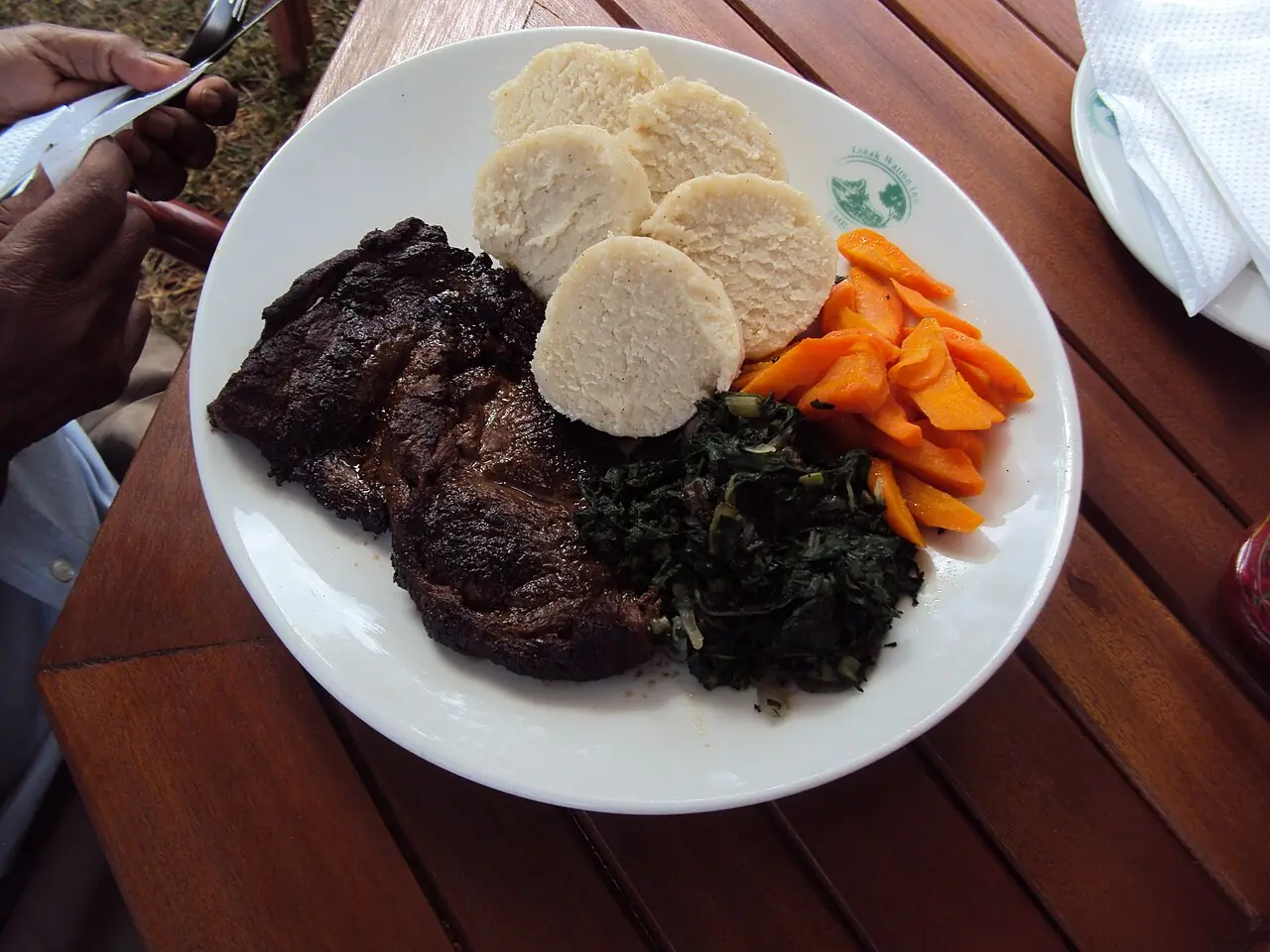 Photo: Napendakukula · CC BY-SA 4.0
Published by Adama Doumbia, founder of Afrique Unie · updated 28 November 2026 · our method and sources
In Kenya, a meal without ugali is not quite a meal. This firm porridge of white maize flour cooked in water is the staple food of the whole of East Africa. Each of the country's peoples has its own name for it: ngima for the Kikuyu, kuon for the Luo, kimnyet for the Kalenjin. It is eaten almost every day, at home and in the small canteens of Nairobi alike.
Its faithful partner is sukuma wiki: collard greens, a large-leaved green cabbage, finely shredded and fried with onions and tomatoes. In Swahili its name means 'push the week' or 'stretch the week': this cheap vegetable, available all year round, helps the household budget last until payday.
Ugali is eaten with the right hand: you pinch off a small ball, press a dip into it with your thumb and use it like a spoon to scoop up the greens. On special occasions, the pair goes with nyama choma, the grilled meat Kenyans love to share at weekends.
Ingredients
For the ugali
- 1 litre (1 3/4 pints) water
- About 400 g (14 oz) fine white maize flour (maize meal, from African grocers)
- 1 pinch of salt (optional)
For the sukuma wiki
- 600 g (1 lb 5 oz) collard greens (or kale), about 2 bunches
- 2 tablespoons vegetable oil
- 1 large red onion, thinly sliced
- 2 ripe tomatoes, diced
- 1 garlic clove, chopped (optional)
- 1 small green chilli, sliced (optional)
- 1 pinch of stock powder or 1/2 teaspoon salt
- 3 tablespoons water
Method
- Wash the greens thoroughly. Cut out the thick central stalk, stack the leaves, roll them up tightly and slice them into very thin ribbons, 2 to 3 mm wide. This fine cut is what allows quick cooking.
- For the ugali, bring the water (and salt) to the boil in a heavy-based saucepan. Sprinkle in about a third of the flour while whisking to make a smooth porridge. Cook for 3 minutes.
- Add the rest of the flour a little at a time, stirring vigorously with a sturdy wooden spoon. Press out any lumps against the side of the pan. The mixture gets thicker and harder to stir: this is normal. Stop adding flour when it pulls away from the sides and forms a firm mass.
- Turn the heat down to the lowest setting. Keep stirring and folding the dough for 6 to 8 minutes, pressing it against the sides of the pan. It should lose its raw flour taste and smell of toasted maize. A thin crust forms on the bottom: that is a good sign.
- Wet a bowl with water, tip the ugali into it and press it down with the spoon. Turn it out onto a plate to get a smooth dome. Cover with a tea towel to keep warm.
- For the sukuma wiki, heat the oil in a wide frying pan. Fry the onion for 4 to 5 minutes until soft and golden, then add the garlic and chilli for 1 minute.
- Add the tomatoes and cook for 4 to 5 minutes, crushing them with the spoon, until you have a thick sauce.
- Add the shredded greens, salt or stock powder and water. Mix well, cover and cook for 5 to 8 minutes over a medium heat, stirring once or twice. The greens should stay bright green with a slight bite.
- Serve straight away: a thick slice of ugali with a generous helping of sukuma wiki alongside. Eat with the fingers of your right hand, the Kenyan way.
Tips and variations
- White maize flour is sold in African grocers and diaspora markets. At a push, very fine polenta will do, but it is yellow and sweeter, so the result will be different.
- The amount of flour depends on how finely it is milled: trust the texture rather than the scales. Ugali should be firm, hold its shape and not stick to wet fingers.
- For a more filling meal, fry 250 g (9 oz) beef mince with the onion before adding the tomatoes, a very common variation in Kenya. Cook the meat until no pink remains.
- To clean the pan, leave it to soak in cold water for an hour: the ugali crust will lift off on its own.
- Leftover ugali can be sliced and fried until golden the next day. Sukuma wiki keeps for 2 days in the fridge.
To serve with it: Serve with nyama choma (grilled meat), a beef stew or fried tilapia, and a hot cup of Kenyan chai.
Have you tried this recipe?
Be the first to rate it.
Thank you for your rating!
Frequently asked questions
What is the difference between ugali, sima and posho?
They are the same dish: ugali is the most common Swahili name in Kenya, sima is used in Tanzania and posho in Uganda. The recipe hardly changes: white maize flour cooked in water until it forms a firm dough.
My ugali is lumpy. What can I do?
Always start with a thin porridge using part of the flour, then add the rest gradually, pressing out lumps against the side. If a few remain, keep working the dough over a low heat and they will disappear.
What can I use instead of collard greens?
Kale is the closest substitute. Chard, spring greens or spinach also work; cut the cooking time to 3 minutes for spinach.
Does ugali have much flavour?
It is deliberately neutral, like bread or rice. Its job is to go with sauces, vegetables and meat, and to fill you up.
Another recipe from Kenya: Nyama choma with kachumbari