 AfriqueUnie
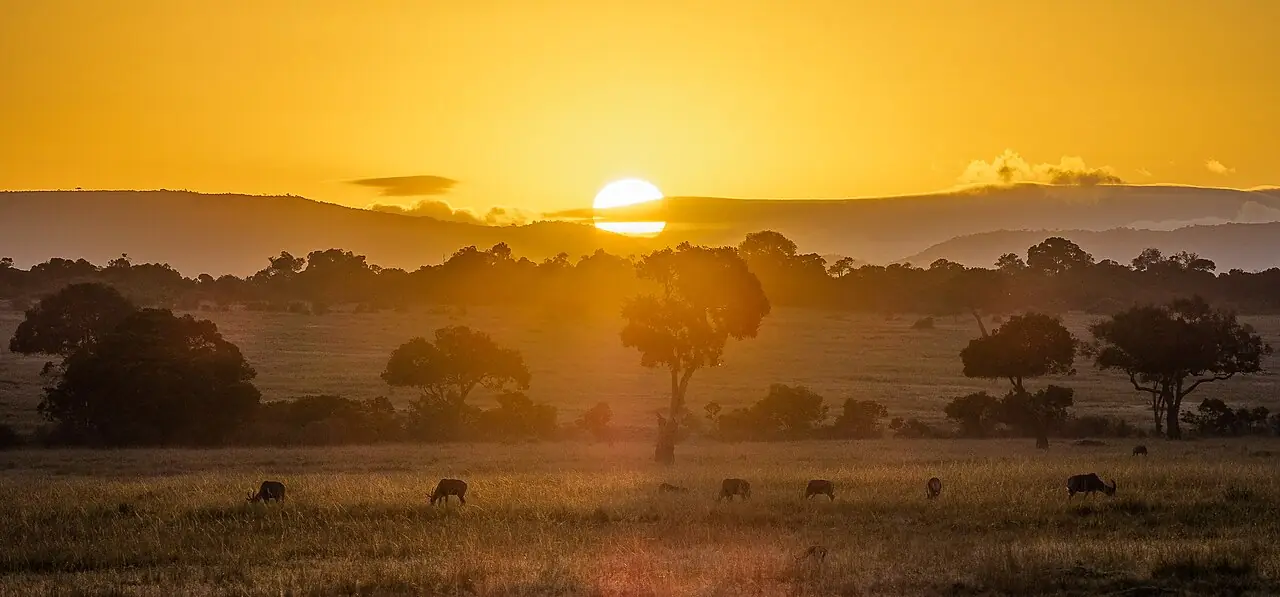 Photo: Danijel Mihajlovic · CC BY-SA 4.0
Published by Adama Doumbia, founder of Afrique Unie · updated 28 November 2026 · our method and sources
Daily budget
These are rough figures per person per day, excluding the international flight. They cover accommodation (two people sharing a room), meals and local transport.
On a tight budget, allow roughly €50 to €90 outside safari days, staying in small hotels or hostels, eating local food and using public transport. Each day on a group safari, camping or in a simple camp, adds substantially to that. For a comfortable trip, allow about €200 to €400 while on safari in a mid-range camp or lodge, with park fees and vehicle included. At the top end, allow €600 or more, and far beyond that in luxury camps and private conservancies, especially in high season.
On the coast or in Nairobi, away from the parks, a comfortable trip costs much less.
What is expensive and what costs next to nothing
- Safari: The biggest cost: four-wheel-drive vehicle, driver-guide, bush accommodation and park fees. Sharing the vehicle is the most effective way to cut it.
- Parks and reserves: Entry fees are charged per person per day, with a non-resident rate. They vary by park and season. See kws.go.ke for the national parks; the Maasai Mara, run by Narok County, has its own price list.
- Accommodation: Affordable in towns, expensive in and around the parks.
- Local meals: A plate of nyama choma or ugali in a local restaurant costs a few euros.
- Transport: Buses, matatus and the Nairobi–Mombasa train are cheap. Domestic flights to bush airstrips save time at a high price.
Money: shillings, M-Pesa and tipping
The currency is the Kenyan shilling (KES). Cash machines are plentiful in Nairobi, Mombasa and other towns. Cards are widely accepted in hotels, lodges and supermarkets, and for national park fees, which are paid cashless.
M-Pesa mobile payment is used everywhere, from taxis to market stalls. It needs a local SIM card, registered with your passport. For a short stay, a bank card and a little cash are enough. Many safari operators accept US dollars: bring recent notes in good condition.
Tipping is expected on safari, for the driver-guide and camp staff. Ask your operator what is customary and bring the amount in cash. In restaurants, leave around 10% if service is not included.
Travel authorisation (eTA) and passport
Information checked in November 2026. These rules can change: read the official sources again before you travel.
Kenya no longer issues a standard tourist visa. British and French travellers, like other Europeans, Swiss and Canadians, must obtain an electronic travel authorisation (eTA) before departure through the official portal, etakenya.go.ke. It is checked at boarding. Apply several days ahead: normal processing takes about three working days.
Price: secondary sources most often quote 30 US dollars for single entry, but we were unable to read the fee on the portal itself. Check it on etakenya.go.ke, the only official address, and avoid intermediary sites that charge more.
New: since 5 October 2026, local health insurance must be bought during the eTA application, even if you already have cover. According to the UK government it is valid for 90 days. Several sources quote a premium of 44 dollars plus a service fee: confirm this on the portal.
Passport: the UK government says it must expire at least six months after you arrive and have two blank pages. Tourist stays are limited to three months.
Health and vaccinations
Yellow fever: a vaccination certificate is required if you arrive from a country where the disease is present, or have spent more than twelve hours in transit there. In principle it is not required for a direct flight from Europe. The French foreign ministry still advises vaccination, as the disease is present in central and western Kenya. It is given at a designated yellow fever centre, at least ten days before departure.
Malaria is present across much of the country. The risk is low in Nairobi and markedly higher on the coast and around Lake Victoria. Bite avoidance and preventive medication should be decided with a doctor, according to your route.
Check your routine vaccines too, and ask about hepatitis A, typhoid and rabies.
Before you go: the checklist
- eTA: Apply at etakenya.go.ke several days before you leave, including the compulsory local insurance. Print the authorisation.
- Passport: Six months' validity after arrival and two blank pages.
- Health: Book a travel clinic appointment for yellow fever and malaria.
- Official sources: The Kenya page on gov.uk/foreign-travel-advice and the Kenya page of « Conseils aux voyageurs » on diplomatie.gouv.fr: some areas are advised against.
- Your own insurance: The local policy does not replace cover for repatriation and evacuation from the bush.
- Plastic bags: Single-use plastic bags are banned in Kenya: leave them out of your luggage.

