AfriqueUnie
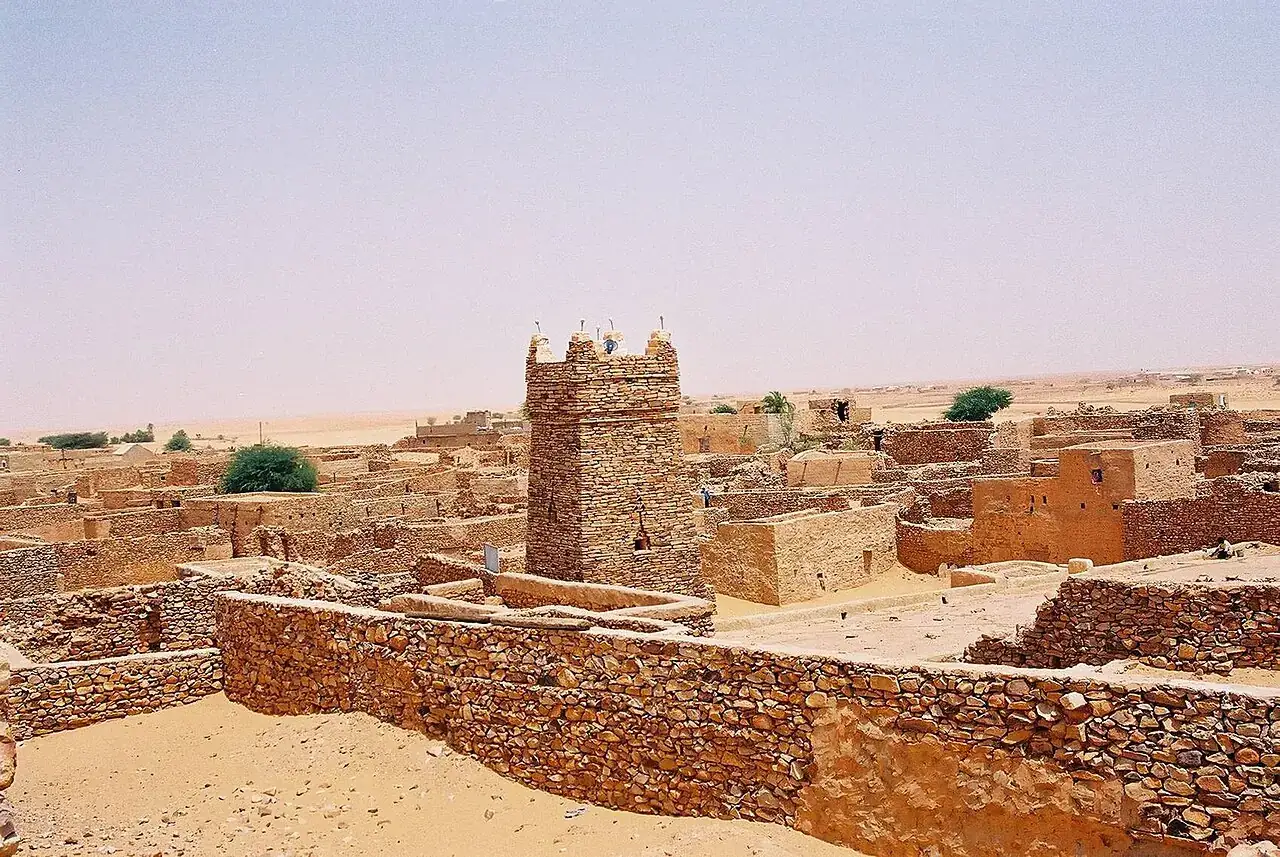 Photo: François COLIN · CC BY-SA 2.5
Published by Adama Doumbia, founder of Afrique Unie · updated 28 November 2026 · our method and sources
Daily budget
These are rough figures per person per day, excluding the international flight, visa and vaccines. They cover accommodation (two people sharing a room), meals, local transport and a few visits.
On a tight budget, allow roughly €35 to €60, staying in hostels or small hotels, eating simply and travelling by bush taxi. For a comfortable trip, allow about €80 to €150, with a good hotel in Nouakchott or Nouadhibou and guesthouses in the Adrar, plus a vehicle and driver for some legs. At the top end, allow €200 or more, for a private 4x4 desert tour with a guide.
Transport is the big cost: distances are huge and desert tracks need an off-road vehicle, ideally two, and an experienced guide.
What is expensive and what costs next to nothing
- Vehicle and guide: Hiring a 4x4 with driver for the Adrar (Chinguetti, Ouadane, the Richat Structure) or the Banc d'Arguin is most of the budget. Share it with others.
- Accommodation: Guesthouses and camps in the Adrar are affordable; business hotels in Nouakchott are much dearer.
- Local meals: Rice with fish, méchoui or couscous at a local place costs little. Importing alcohol is banned and it is almost impossible to find.
- Iron ore train: A legendary and cheap experience, but the UK points out that riding outside the passenger carriages is illegal and carries a serious risk of injury.
- Visa: Budget for it from the start: €55 in cash on arrival, according to the French foreign ministry.
Money: ouguiya, cash and exchange
The currency is the ouguiya (MRU). You can exchange euros and US dollars at banks, some hotels and official bureaux de change; pounds only at some bureaux and at a poor rate, according to the UK. Bringing in and taking out foreign currency must be declared: keep your exchange receipts.
The UK describes Mauritania as mainly cash-based. A few hotels in Nouakchott and Nouadhibou accept cards, some only Visa, and some cash machines take foreign cards. Outside those two cities, do not count on them: bring enough euros for your whole time in the desert.
Set aside the exact visa fee in euros or dollars: the UK says no change is given at the counter.
Tips are appreciated by guides, drivers and cooks: agree on them in advance.
Visa and passport
Information checked in November 2026. These rules can change: read the official sources again before you travel.
Since 5 January 2025, the visa has been a two-step process. First, an electronic visa authorisation obtained before travel on anrpts.gov.mr, the website of the national agency for secure documents: it is checked when you board and again when you leave the country. Then the visa itself is issued at the point of entry (airports, ports, international land crossings), with biometric capture and a fee of €55 for 30 days single entry, according to the French foreign ministry. Print the authorisation.
The UK government gives the same process for British citizens, with payment in exact cash, in euros or US dollars, and a passport valid for at least six months after the date you arrive. Apply well in advance. Other Europeans, Swiss and Canadian nationals are also covered, according to the sources we consulted: check on the portal.
Enter only through an "international" border post (Nouakchott and Nouadhibou airports, PK 55, Rosso, Diama…). France formally advises against the Gogui crossing towards Mali. Overstays must be regularised for the price of a visa before you can leave.
Health and vaccinations
Yellow fever: a certificate is required from travellers arriving from a risk country, from the age of one, including after a transit of more than twelve hours. Vaccination is recommended for travel south of the Sahara, but not for travel limited to the Sahara. The French foreign ministry calls it strongly recommended for everyone and says the certificate may be asked for in any case: carry it if you are vaccinated.
Malaria is present everywhere except the Dakhlet Nouadhibou and Tiris Zemmour regions, according to the US health authorities (CDC). The risk is mainly in the south, along the Senegal River. Prevention is decided with a doctor according to your route.
Check your routine vaccines too, and ask about hepatitis A, typhoid and rabies. Outside Nouakchott, emergency care is very limited: insurance covering medical evacuation is essential.
Before you go: the checklist
- Safety: The UK advises against all travel east of a line through Kankossa, Akhreijit, Ghallaouia, Zouerat and Fderîck, and within 25 km of the Malian border, and against all but essential travel to large parts of several provinces. The British Embassy in Nouakchott cannot provide consular services in person: contact the embassy in Dakar. Check your route on the official maps.
- Visa authorisation: Apply on anrpts.gov.mr before you leave, print it and keep it until you exit.
- Cash: The exact €55 visa fee, plus euros for the whole trip.
- Alcohol: Importing it is banned: even a small amount can lead to arrest.
- Official sources: Mauritania page on gov.uk/foreign-travel-advice and the Mauritanie page of « Conseils aux voyageurs » on diplomatie.gouv.fr.
- Insurance: Medical costs and evacuation, including from the desert.