AfriqueUnie
 Photo: Arnault · CC BY-SA 2.0
Published by Adama Doumbia, founder of Afrique Unie · updated 28 November 2026 · our method and sources
Before you go: journey times and safety
The times given are rough estimates from central Dakar outside rush hour. Getting off the peninsula can be very slow on Friday evenings, and the Sunday-evening return to Dakar almost always is: leave early and allow plenty of time. The toll motorway towards Blaise Diagne Airport, Thiès and Mbour saves a lot of time on the way to the Petite Côte.
France Diplomatie does not advise against travel to Dakar or the Petite Côte; only certain areas of Casamance and the east of the country, far from this page, are subject to restrictions. Avoid driving at night, especially on main roads, and beware of currents: only swim where local people do.
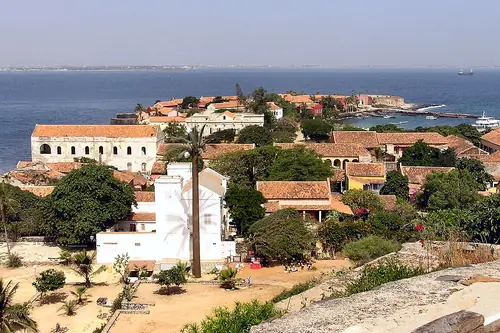
Gorée Island: memory and calm (20 minutes by boat)
The ferry leaves from the maritime station on the Plateau and reaches the island in about twenty minutes. Car-free and a UNESCO World Heritage Site, Gorée combines places of remembrance of the slave trade, including the House of Slaves, colourful houses draped in bougainvillea and a small beach.
At weekends, sailings are more frequent but the island is also busier: catch one of the first boats on Saturday. Half a day is enough; a night in a guesthouse lets you see the island after the visitors have gone.
Lake Retba: the colour and the salt harvesters (about 1 hour)
North-east of Dakar, Lake Retba owes its pink hue to micro-organisms that thrive in its very salty water. Salt harvesters work it by hand, and a dugout canoe trip lets you watch them up close. The colour shows best in the dry season, when the sun is high.
Half a day is enough. As Blaise Diagne Airport is only about forty-five minutes away, the Pink Lake also makes a good stop when meeting or seeing off a friend.
Toubab Dialaw and Popenguine: cliffs and villages (about 1 to 1½ hours)
South-east of Dakar, the coast changes character: ochre cliffs, coves and fishing villages. Toubab Dialaw, popular with artists, draws Dakar residents who want a break without going far. A little further south, Popenguine is known for its nature reserve, its clifftop trails and its Marian shrine, the scene of a major Catholic pilgrimage at Pentecost.
A day is enough; a night lets you enjoy the calm and the sunset. On the Pentecost weekend, Popenguine welcomes huge numbers of pilgrims, so avoid it if you are looking for peace and quiet.
The Petite Côte: Saly, La Somone and Bandia Reserve (about 1½ hours)
Via the toll motorway, Saly and the Petite Côte are the classic seaside escape for Dakar weekends: long beaches, a sea that is usually calmer than in Dakar and plenty of places to stay. Nearby, the mangrove-fringed La Somone lagoon can be explored by dugout canoe, with lots of birds.
On the way, Bandia Reserve lets you see giraffes, rhinos and antelopes, introduced into the reserve, from a vehicle with a guide. It is a favourite family outing; come early in the morning, when the animals are active and the heat bearable.
Joal-Fadiouth: the shell island (about 2 hours)
At the end of the Petite Côte, Fadiouth is an island built largely of shells, linked to Joal by a long wooden bridge. You explore it on foot, through its lanes, its granaries on stilts and the cemetery shared by Christians and Muslims, a symbol of good relations between the two communities.
Visit with a local guide, who will tell you its story, and combine it with the Petite Côte for a full weekend.
Lompoul desert: a night in the dunes (about 3 hours)
Between Dakar and Saint-Louis, a few kilometres from the ocean, the Lompoul desert is an island of tall orange dunes. People spend a night under canvas, in camps set among the sand, for the sunset and sunrise.
Leave on Saturday morning to arrive before the heat and drive back on Sunday in daylight. The last stretch is often done by 4x4, arranged with your accommodation. Nights can be cool between December and February, so bring a jacket.
For a long weekend: the Saloum Delta and Saint-Louis
The Saloum Delta, three to four hours away by road, deserves at least two nights: mangrove-lined channels, islands and villages reached by dugout canoe, and birds by the thousand from November to April. Saint-Louis, about four hours away, also needs two nights for its World Heritage island and, in season, Djoudj National Park.
When to get out of Dakar
- November to June: The dry season: blue skies, easy roads and the Pink Lake at its best. From December to March it is cooler, and the harmattan can veil the sky with dust.
- July to October: The rainy season: humid heat, storms and occasionally cut roads, but green landscapes. The Saloum Delta and the Petite Côte remain accessible with some flexibility.
- Holidays and long weekends: Major religious festivals and school holidays fill the Petite Côte and slow the roads: book early and set off in good time.
Further reading
- Dakar: things to do, districts, safety
- Dakar in 3 days
- Gorée Island
- Lake Retba (Pink Lake)
- Saloum Delta
- Saint-Louis
- Senegal: our country guide
- When to go to Senegal: the weather month by month
- Senegal: budget and entry requirements: visa, health, money
- Useful Wolof phrases: to say hello and thank you