 AfriqueUnie
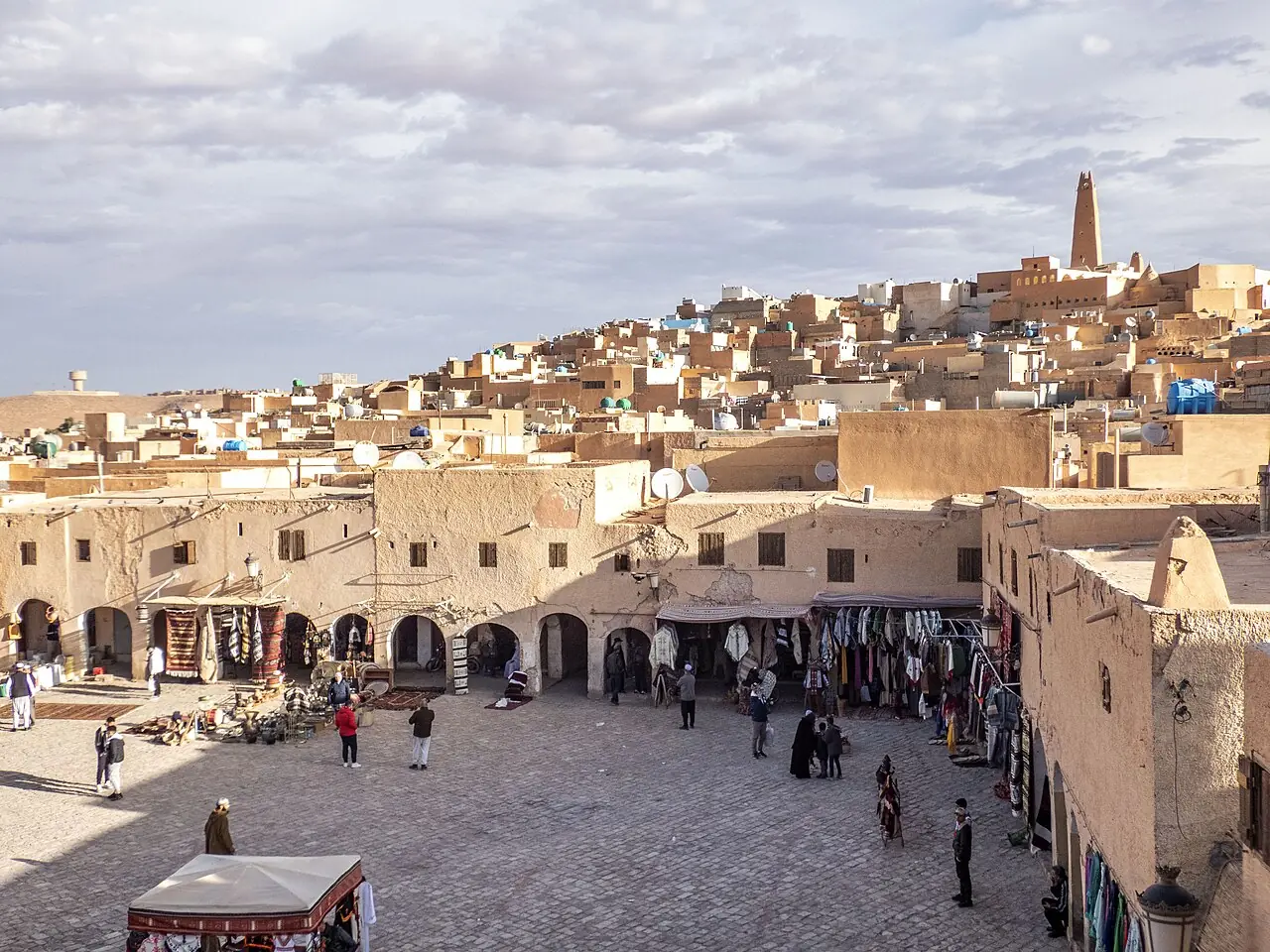 Photo: Camille Gillet · CC BY-SA 4.0
Published by Adama Doumbia, founder of Afrique Unie · updated 28 November 2026 · our method and sources
- Days 1-2
Algiers, from the Casbah to Notre-Dame d'Afrique
Once in Algiers, start with the seafront and the grand colonial-era boulevards around the Grande Poste and Didouche Mourad street. The next morning, devote a few hours to the UNESCO-listed Casbah: its stepped lanes, Ottoman palaces such as the Palais des Raïs and old mosques are best explored with a local guide, as the district is a real maze. In the afternoon, go up to the Basilica of Notre-Dame d'Afrique for the view over the bay, then head down to the Jardin d'Essai du Hamma, at the foot of the Martyrs' Memorial. The Bardo National Museum, devoted to prehistory and ethnography, rounds off this first look at the city.
- Day 3
Tipaza and Cherchell, ruins by the sea
About an hour and a half's drive west of Algiers, Tipaza is one of the finest ancient sites in the Mediterranean: a Roman forum, basilicas and baths spread out between the pine trees and the sea, at the foot of Mount Chenoua. On the way, stop at the Royal Mausoleum of Mauretania, often called the Tomb of the Christian Woman, an imposing circular monument on a hilltop. If time allows, continue to Cherchell, ancient Caesarea, some thirty kilometres further on, for its museum full of mosaics and statues. Return to Algiers before dark, sticking to the main roads as the authorities recommend.
- Days 4-5
Oran, the home of raï
Fly to Oran: the flight from Algiers takes about an hour. Avoid the train and the road, which cross Aïn Defla province, where the French authorities advise against all but essential travel. Algeria's second city, Oran blends Spanish, Ottoman and French heritage. Go up to Santa Cruz fort and the neighbouring chapel, on the slopes of Mount Murdjadjo, for a sweeping view of the bay and the port. The next day, wander through the old Sidi El Houari district, along the seafront boulevard and around 1 November Square and its theatre. In the evening, enjoy the city's more relaxed atmosphere: this is the birthplace of raï music. Avoid, however, the border area with Morocco further west.
- Days 6-7
Constantine, the city of bridges
Fly to Constantine, on a direct domestic flight or via Algiers depending on the day. Perched on a rock split by the Rhumel gorges, the city is spectacular: cross the Sidi M'Cid suspension bridge and the Mellah Slimane footbridge, then follow the paths along the gorges when they are open. Visit the Palace of Ahmed Bey, a fine Ottoman ensemble with planted courtyards, and the Cirta Museum for Numidian and Roman history. The next day, take a trip to the ancient site of Tiddis, some thirty kilometres north-west, clinging to a rocky spur above the Rhumel. Djemila and Timgad, located in provinces where travel is advised against except when essential, are not included.
- Days 8-9
Ghardaïa and the M'zab Valley
Fly to Ghardaïa, usually via Algiers, on the edge of the Sahara. The M'zab Valley, a World Heritage Site, brings together five ksour founded from the 11th century onwards: Ghardaïa, Melika, Beni Isguen, Bounoura and El Atteuf. Their pastel-coloured cubic houses rise in tiers around a mosque whose minaret towers over each town. Beni Isguen is visited with a local guide: follow the rules, especially regarding photos and dress. On the second day, explore the palm grove and its old water-sharing systems, then the market in Ghardaïa. As the roads south of the town are isolated, continue your journey by plane.
- Day 10
Arrival in Tamanrasset, in the heart of the Hoggar
Take a domestic flight to Tamanrasset, usually with a connection in Algiers: allow a good part of the day. In the Sahara, you cannot travel without a guide: the stay is organised with a licensed agency, which handles the permits and accompanies all trips, sometimes with an escort. Spend the afternoon discovering the town, capital of the Hoggar Tuareg, with its market and Father de Foucauld's bordj, then watch the sunset over the surrounding mountains. In the evening, go over your equipment with your guide: nights are cool, even cold in winter, and you need to carry plenty of water.
- Days 11-12
Assekrem and the volcanoes of the Atakor
Set off by 4x4 for the Assekrem plateau, about eighty kilometres north of Tamanrasset: the track crosses the Atakor, a landscape of basalt columns and volcanic peaks, and takes several hours. A short climb leads to the hermitage built by Charles de Foucauld in 1911, at almost 2,800 metres. Sleep at the refuge or in a camp to watch the sunset and above all the sunrise over the peaks, one of the most famous views in the Sahara. The next day, drive back down to Tamanrasset, stopping at gueltas and nomad camps along the way as your guide suggests. Pack very warm clothes: it often freezes at night in winter.
- Days 13-14
Back to Algiers and departure
Fly back to Algiers and the mild climate of the coast. Depending on your arrival time, spend the rest of the day on what you missed at the start of the trip: the National Museum of Fine Arts above the Jardin d'Essai, the Pêcherie district and the Ketchaoua Mosque at the foot of the Casbah, or a walk in the hills of El Biar. On the last day, leave plenty of time to reach the airport: traffic in Algiers is often heavy, and boarding checks can take a while. If your flight leaves late, the Great Mosque of Algiers, on the way to the airport, is worth a stop.
Getting around
For long distances, flying is the safest and fastest option: domestic flights link Algiers to Oran, Constantine, Ghardaïa and Tamanrasset, often with a connection in Algiers. Between Algiers and Oran, fly as well: the railway and the motorway cross Aïn Defla province, where travel is advised against except when essential. For day trips around Algiers and Constantine, hire a car with a driver or go with a local guide, sticking to main roads and avoiding driving after dark. In the Sahara, using a licensed agency and a guide is compulsory. Official travel advice changes: check it before you leave and follow the instructions of the Algerian authorities on the ground.
When to do this trip
To combine the north and the Sahara, aim for spring, from March to April, or autumn, from October to November: the coast is mild and the heat remains bearable in the desert. May is still fine in the north, but the south becomes very hot. From December to February, the Sahara is pleasant by day but freezing at night, especially at Assekrem, while the coast is cool and sometimes rainy. Avoid the Sahara in summer. During Ramadan, restaurant and opening hours change.
The travel notebook
The itinerary, practical information (entry, health, money, emergencies) and the checklist in a few pages, to print or keep offline on your phone.
Variations
- In 10 days: drop Oran and Constantine, and combine Algiers, Tipaza, the M'zab Valley and the Hoggar.
- Mediterranean version: outside the Saharan season, replace Ghardaïa and Tamanrasset with a few more days on the coast around Tipaza and Oran.
- Desert version: add three or four days of camel trekking or a 4x4 tour in the Hoggar, organised by a licensed agency.