 AfriqueUnie
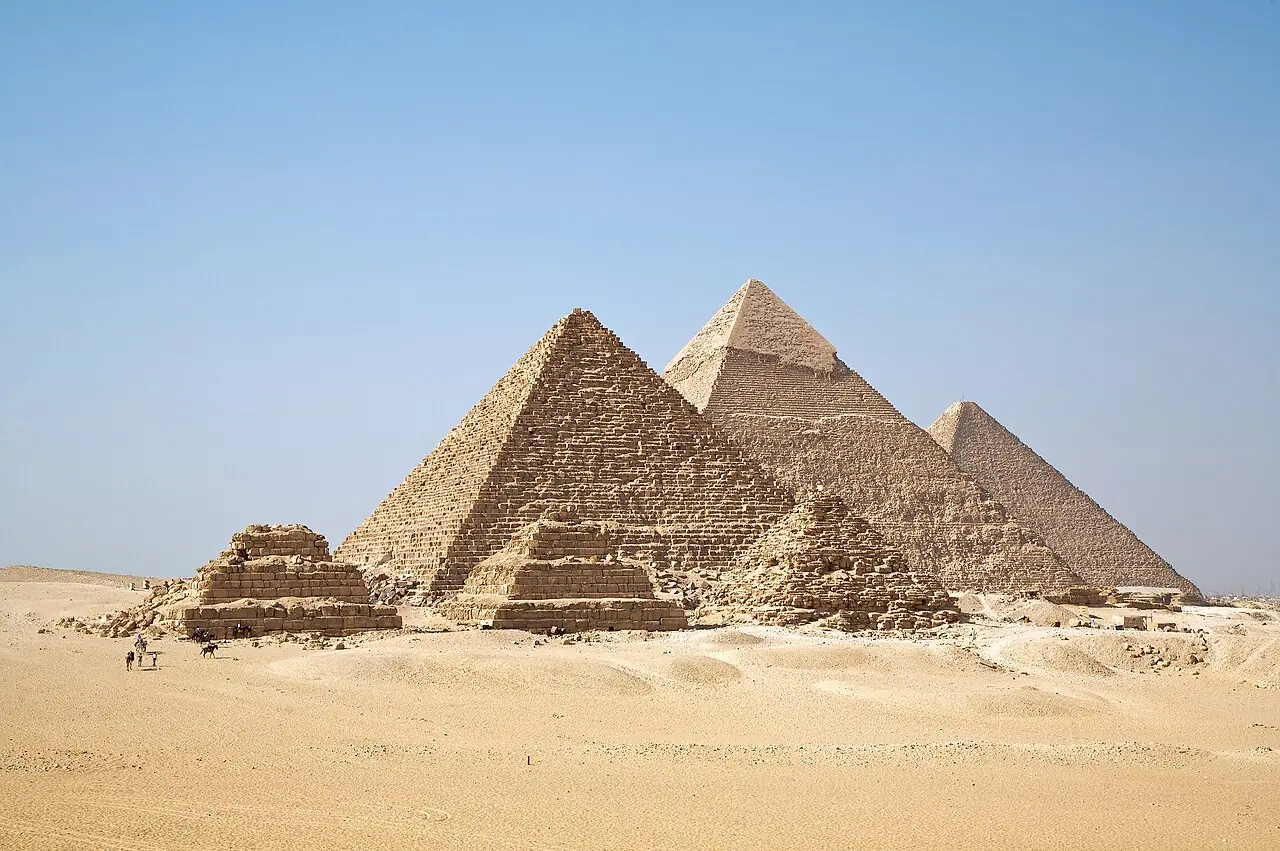 Photo: Ricardo Liberato · CC BY-SA 2.0
Published by Adama Doumbia, founder of Afrique Unie · updated 28 November 2026 · our method and sources
- Days 1-2
Cairo and the Pyramids of Giza
After you arrive, stay on the Giza side if you can, to be at the foot of the pyramids as soon as the site opens. The next morning, explore Khufu, Khafre and Menkaure, then the Sphinx, before the heat and the crowds build. In the afternoon, move on to the Grand Egyptian Museum, close to the plateau, whose vast galleries trace pharaonic history and display the treasures of Tutankhamun. If you still have energy, continue to Saqqara and the Step Pyramid of Djoser, around forty minutes' drive away and often quieter. In the evening, a felucca ride on the Nile gives a calmer first view of the megacity, which never really sleeps.
- Day 3
Islamic Cairo, then a flight to Aswan
Spend the morning in historic Cairo. Climb up to the Citadel of Saladin and the Mosque of Muhammad Ali, whose terrace overlooks the city, then head down to Al-Azhar Mosque and Al-Muizz Street, lined with restored Mamluk mosques and palaces. Finish at the Khan el-Khalili bazaar for tea in one of its historic cafés and a little shopping, haggling with a smile. If time allows, the Coptic quarter and its ancient churches round off the picture nicely. In the late afternoon, take a domestic flight of about an hour and a half to Aswan, where the slower, gentler Nubian atmosphere is an instant contrast with the capital.
- Day 4
The temples of Abu Simbel
The alarm goes off very early: Abu Simbel lies about three and a half hours' drive south of Aswan across the desert, and you leave before dawn to arrive at opening time. A short flight is also available, more expensive but less tiring. The two temples carved into the cliff by Ramesses II, one for himself and the other for his wife Nefertari, are among the most striking in Egypt. They were dismantled and rebuilt higher up in the 1960s to escape the waters of Lake Nasser. Take time to read the scenes of the Battle of Kadesh. Return to Aswan in the early afternoon for a well-earned rest.
- Day 5
Aswan, Philae and the feluccas
In the morning, take a boat to the Temple of Philae, dedicated to Isis and also moved to a neighbouring island when the dams were built. Its setting, surrounded by water and granite boulders, is one of the loveliest in the valley. Have a look at the High Dam, then the Unfinished Obelisk, still lying in its quarry. In the afternoon, board a felucca to sail around Elephantine Island and the botanical garden on Kitchener's Island, before visiting a Nubian village of painted houses on the west bank. Then board your cruise boat, which stays moored in Aswan for the first night.
- Days 6-7
Cruising the Nile to Luxor
The boat sails north down the river. The first stop is Kom Ombo, a double temple dedicated to the crocodile god Sobek and the falcon god Haroeris, with its small museum of mummified crocodiles. Further on, Edfu is home to the Temple of Horus, one of the best preserved in Egypt, with its monumental pylon and intact sanctuary. Between visits, enjoy the sun deck as palm groves, villages and sugar cane fields slide past. Passing through the Esna lock is a curious experience. You reach Luxor on day 7: in the afternoon, visit the vast Karnak temple and its hypostyle hall, then Luxor Temple, superb once lit up after dark.
- Day 8
Luxor's West Bank
Cross the Nile at sunrise, when hot-air balloons sometimes drift over the West Bank. Start with the Valley of the Kings: the entry ticket covers several tombs, while some, such as those of Tutankhamun or Seti I, require an extra ticket. The colours of the paintings, intact after more than three thousand years, are astonishing. Continue to the Temple of Hatshepsut, set against the cliffs of Deir el-Bahari, then the Colossi of Memnon. If you still have energy, the Tombs of the Nobles and Medinet Habu are quieter. Leave the boat and spend the night in Luxor, in town or on the more peaceful West Bank.
- Days 9-10
Rest and snorkelling on the Red Sea
About four and a half hours' drive across the Eastern Desert takes you from Luxor to Hurghada, on the Red Sea. After a week of temples, it is time for turquoise water: coral reefs can be reached from the beach in some bays, or by boat trip to the offshore islands, with a mask and snorkel or on a guided dive. Parrotfish, clownfish and sometimes turtles are there to greet you. On the last day, enjoy a morning swim before heading to Hurghada airport, which has plenty of flights to Europe. If your flight home leaves from Cairo, a domestic flight of about an hour gets you there easily.
Getting around
Domestic flights between Cairo, Aswan, Luxor and Hurghada save precious time. The sleeper train also links Cairo and Aswan in around twelve hours. Between Aswan and Luxor, a three-night cruise is the most enjoyable option; the road, in three to four hours, is also possible. For Abu Simbel, book your transfer or flight in advance. In Cairo, ride-hailing apps make getting around much easier.
When to do this trip
From October to April, temperatures are pleasant everywhere, with cool nights in December and January. This is also high season: book the cruise and flights early, especially for Christmas and Easter. From May to September, the heat often tops 40°C in Aswan and Luxor, so sightseeing happens at dawn. The Red Sea, meanwhile, is good for swimming almost all year round.
The travel notebook
The itinerary, practical information (entry, health, money, emergencies) and the checklist in a few pages, to print or keep offline on your phone.
Variations
- In 7 days: drop the Red Sea and one of the Cairo days, and fly home from Luxor.
- In 14 days: add Alexandria and its Mediterranean corniche as a return trip from Cairo, and extend your Red Sea stay to four nights.
- Diving version: cut Cairo to one day and spend four days on the Red Sea, around Hurghada or Sharm El Sheikh, to explore the reefs.