AfriqueUnie
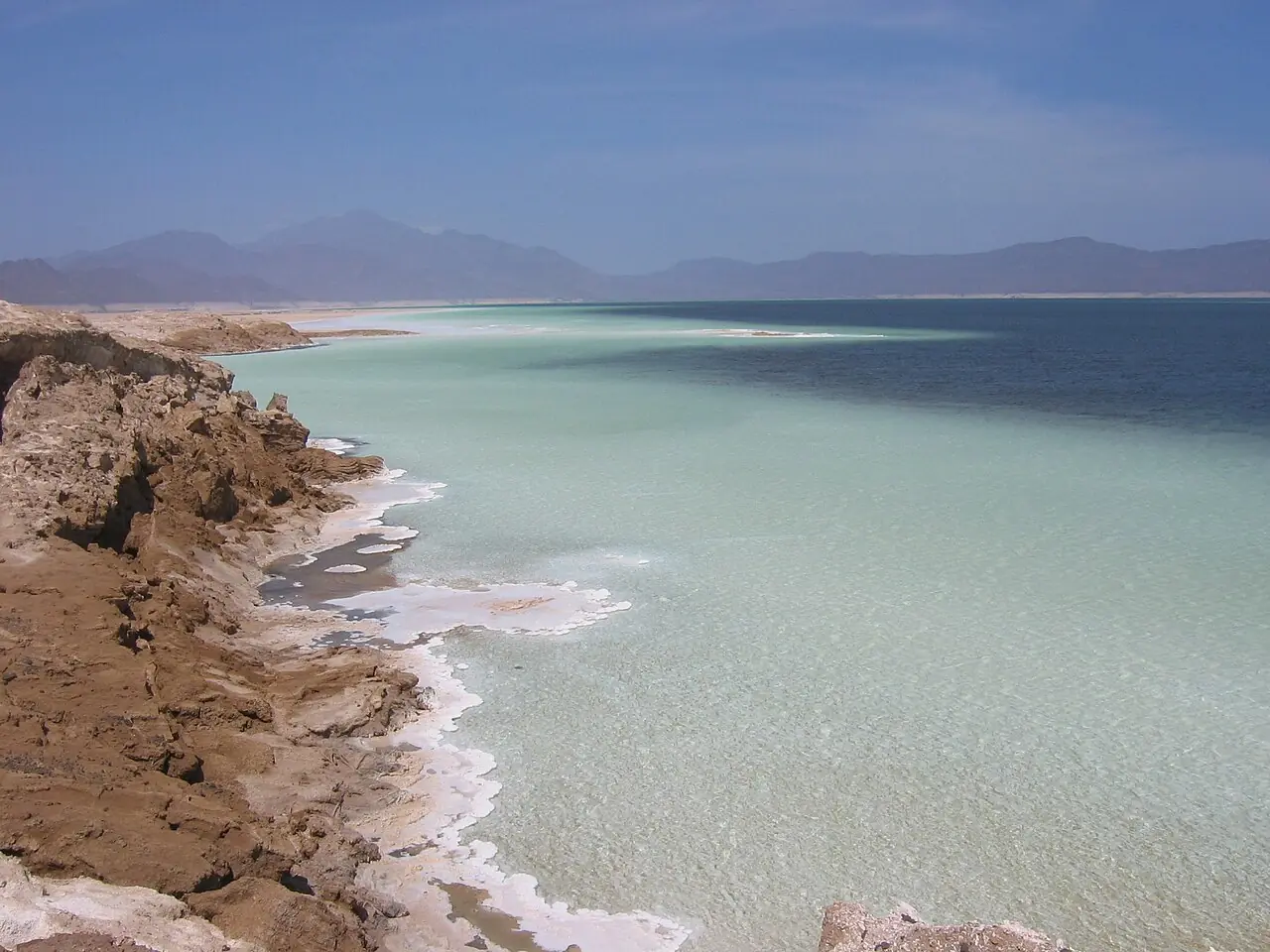 Photo: Tyke · CC BY 3.0
Published by Adama Doumbia, founder of Afrique Unie · updated 28 November 2026 · our method and sources
Why go
Some 155 metres below sea level, Lake Assal is the lowest point on the African continent. You descend by a winding road that snakes between flows of black lava, then the horizon opens onto an unreal sight: intensely turquoise water ringed by a thick crust of blinding white salt. The lake is one of the saltiest bodies of water in the world, saltier than the Dead Sea, and it is fed by underground seepage from the nearby gulf.
On the shores the salt forms a crunchy pack that you walk on carefully, and perfectly round salt pearls pile up at the water's edge. Afar caravans still come here to cut slabs of salt, keeping a centuries-old trade alive. Swimming in this dense water is a strange experience: you float effortlessly, but the slightest scratch stings and your eyes must be protected.
Getting there
The lake lies about 120 kilometres west of the capital, around two hours on a well-maintained tarmac road via the Arta region and the Ghoubbet al-Kharab, whose dark waters and Devil's Island deserve a photo stop. Most visitors go through an agency or hire a car with a driver; for journeys inland, France recommends travelling by day in a convoy of at least two 4x4 vehicles. There is no suitable regular public transport.
Frequently asked questions
Can you swim in Lake Assal?
Yes, and you float effortlessly, as the water is about ten times saltier than the sea. Keep your head above water, protect your eyes and avoid bathing with cuts, as the salt stings. Bring fresh water to rinse off: there are no showers and no shade by the lake.
What is the best time to visit Lake Assal?
From October to April, during the cooler season, when temperatures are high but bearable. From May to September, the heat can exceed 50°C at the bottom of the depression, making a visit exhausting or even dangerous. Whatever the season, arrive early in the morning.
How do you get to Lake Assal from Djibouti City?
The lake lies about 120 kilometres west of the capital, roughly two hours on a tarmac road. There is no suitable public transport, so you go by hire car, with a driver or on an organised excursion. For journeys inland, France recommends travelling by day, in a convoy of at least two 4x4 vehicles, carrying 8 litres of water per person per day, as there are almost no facilities on site.
What can you see on the way to Lake Assal?
The road runs along the Ghoubbet al-Kharab, a dark-watered gulf from which Devil's Island rises. Between the Ghoubbet and the lake, lava fields and rift fissures bear witness to recent volcanic activity, such as the 1978 eruption of Ardoukoba. On the lake shore, the salt crust and salt pearls form a unique landscape.
Is Lake Assal dangerous?
The main danger is the heat: dehydration and heatstroke can quickly set in at the lowest point in Africa. The salt crust is sharp and dazzling, hence the need for closed sandals, a hat and sunglasses. The lake is not in the border areas that official advice for Djibouti says to avoid.
 Burundi
 Kenya
 Rwanda