AfriqueUnie
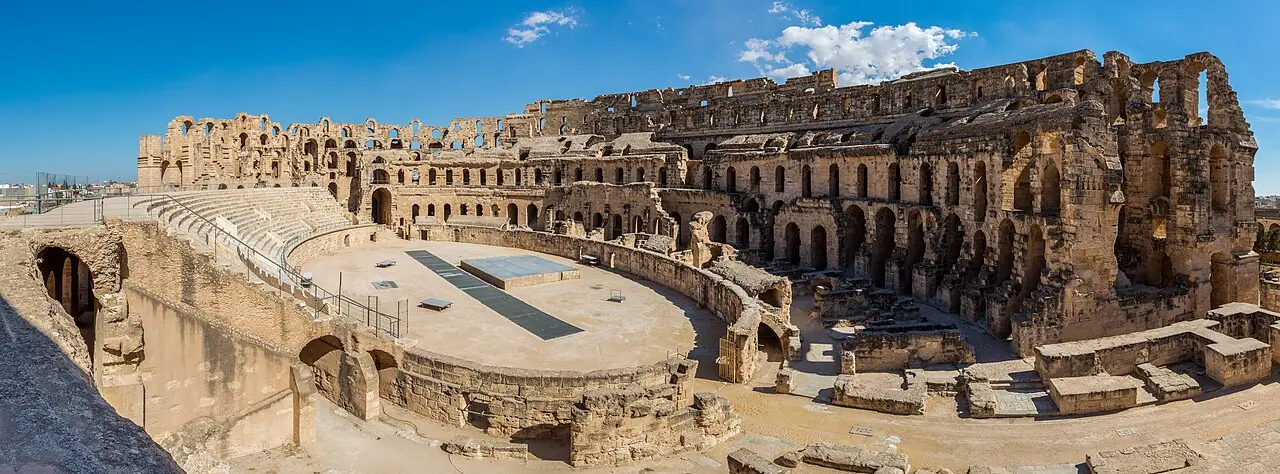 Photo: Diego Delso · CC BY-SA 4.0
Published by Adama Doumbia, founder of Afrique Unie · updated 28 November 2026 · our method and sources
Why go
In the middle of the Sahel's olive-covered plain, the small town of El Jem is dominated by a monument out of all proportion: a 3rd-century Roman amphitheatre, one of the largest ever built, able to hold several tens of thousands of spectators. Built when ancient Thysdrus was growing rich on the olive-oil trade, it has been a UNESCO World Heritage Site since 1979.
It is remarkably well preserved: you can wander the tiers, climb to the upper levels to take in the town and the countryside, and above all go down into the underground passages where wild beasts and gladiators waited before being hoisted up into the arena. The archaeological museum, a few minutes away, displays some very fine mosaics and a reconstructed Roman villa, which round off the visit perfectly.
Getting there
El Jem is about an hour's drive from Sousse and Sfax, and about two and a half hours from Tunis. The town is served by SNCFT trains on the Tunis–Sfax line, with a station a few minutes' walk from the amphitheatre, as well as by louages. The ticket generally covers both the amphitheatre and the museum.
Frequently asked questions
Is the El Jem amphitheatre the largest in Africa?
Yes, it is the largest Roman amphitheatre in Africa, and it is often described as the third largest in the Roman world after the Colosseum in Rome and the amphitheatre at Capua. According to UNESCO, it could hold around 35,000 spectators. Its almost complete façade makes it one of the best preserved.
Can you visit the underground passages at El Jem?
Yes, the underground galleries, where wild animals and gladiators waited before being hoisted into the arena, are open to visitors. You can also climb the stands to the upper levels for views over the town. The stairs are steep and the steps uneven, so take care with children.
How do you get to El Jem from Tunis or Sousse?
SNCFT trains on the Tunis–Sfax line stop at El Jem, a few minutes' walk from the amphitheatre; allow about two and a half to three hours from Tunis. Louages, the shared taxis, also link El Jem with Sousse, Mahdia and Sfax in around an hour. By car, the A1 motorway passes nearby.
What else is there to see in El Jem besides the amphitheatre?
The archaeological museum, about ten minutes' walk away, displays superb mosaics from the wealthy houses of Thysdrus. Behind the museum, a reconstructed Roman villa and a quarter of excavated houses round off the visit. The entry ticket generally covers both the amphitheatre and the museum.
When is the El Jem symphonic music festival?
The International Symphonic Music Festival is held every summer, usually in July and August, in the floodlit amphitheatre. It welcomes Tunisian and international orchestras and soloists for evening concerts. Check the year's programme and book ahead, as concerts often sell out.

 Algeria
 Egypt