AfriqueUnie
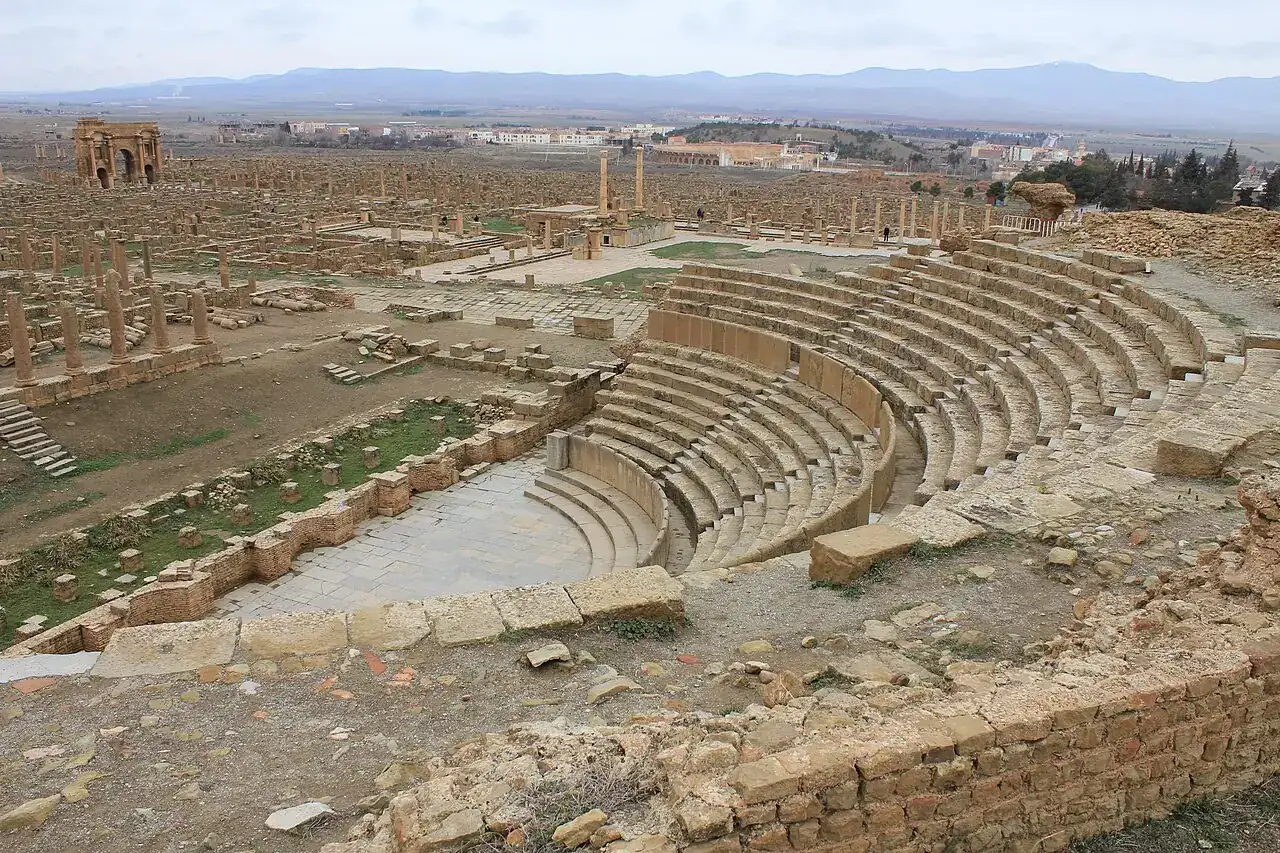 Photo: Xiaotong Gao · CC BY-SA 3.0
Published by Adama Doumbia, founder of Afrique Unie · updated 28 November 2026 · our method and sources
Why go
Founded around AD 100 by the emperor Trajan to settle veterans of his legions, Timgad, ancient Thamugadi, is the most perfect example of Roman town planning in North Africa. Its grid plan, laid out around the cardo and the decumanus, can still be clearly read: you walk along the paved streets between columns, houses, baths and markets as if on an architect's drawing. Listed by UNESCO in 1982, it is nicknamed the Pompeii of Africa.
Its emblematic monument is the so-called Arch of Trajan, which opened the city to the west. The theatre, built against a hillside, the forum, the library, one of the few Roman public libraries ever identified, and the Market of Sertius complete the visit. The town soon outgrew its original plan, and the later districts, a church and a Byzantine fortress show how it evolved. The Aurès mountains, often snow-capped in spring, provide a striking backdrop.
Getting there
Timgad lies about thirty-five kilometres from Batna, roughly half an hour's drive. Batna is linked to Algiers by road, rail and air, and to Constantine by about two hours' drive. An on-site museum displays remarkable mosaics. Tours often combine Timgad with Djémila, another great Roman site, and Constantine.


 Egypt