 AfriqueUnie
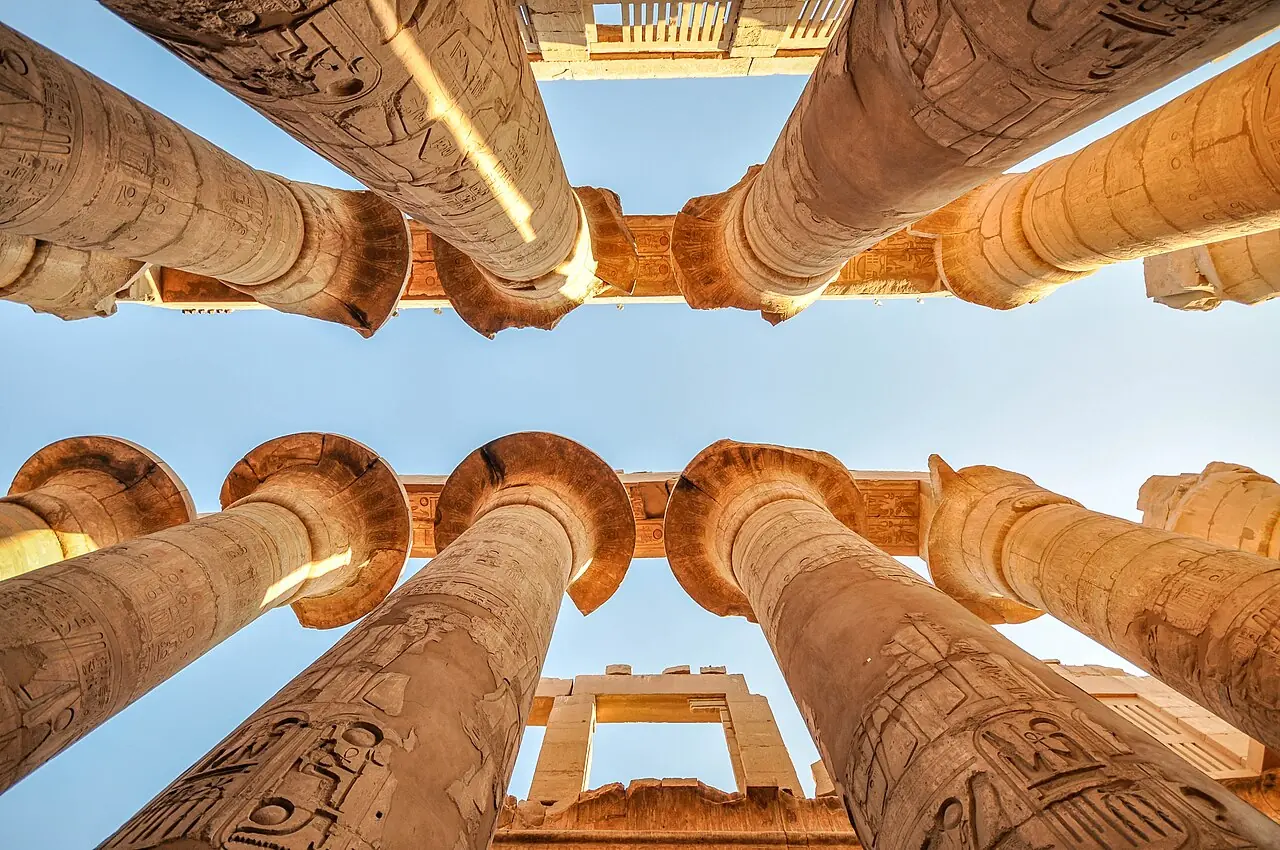 Photo: Jorge Láscar · CC BY 2.0
Published by Adama Doumbia, founder of Afrique Unie · updated 28 November 2026 · our method and sources
Why go
About two and a half kilometres north of central Luxor, Karnak is often described as the largest religious complex of the ancient world. The ancient Egyptians called it Ipet-isut, “the most selected of places”. For nearly two thousand years, from the Middle Kingdom under Senusret I to the Ptolemaic period, some thirty pharaohs added pylons, courts, chapels, obelisks and statues. The result is not a single temple but a true sacred city, dedicated above all to Amun-Ra, the chief god of Thebes. The site is part of Ancient Thebes with its Necropolis, inscribed on the UNESCO World Heritage List in 1979.
You enter through the First Pylon, a 113-metre-long facade that was never finished, then cross a great court before reaching the Hypostyle Hall, the most breathtaking moment of the visit. Across some 5,000 square metres stand 134 sandstone columns arranged in sixteen rows: the twelve columns of the central aisle, about 21 metres high, carry open papyrus capitals, and traces of colour survive on the carved decoration. The hall was built mainly under Seti I and Ramesses II, in the thirteenth century BC.
Further on, the obelisk of Queen Hatshepsut, around thirty metres tall, is one of the tallest ancient obelisks still standing. The sacred lake, where priests purified themselves, and the great stone scarab of Amenhotep III, which visitors like to walk around, punctuate the route. The open-air museum brings together chapels rebuilt block by block, including the White Chapel of Senusret I and the Red Chapel of Hatshepsut. Since 2021, the Avenue of Sphinxes, about 2.7 kilometres long, once again links Karnak with Luxor Temple.
Getting there
Karnak lies on the east bank of the Nile, about two and a half kilometres north of Luxor Temple. Get there by taxi, ride-hailing app or horse-drawn carriage from the town centre, or on foot along the Nile Corniche if you avoid the hottest hours. The Avenue of Sphinxes, reopened in 2021, also lets you walk between the two temples. Luxor airport, with flights from Cairo and Europe, is around twenty minutes' drive away, and day and night trains link Luxor with Cairo and Aswan.
Frequently asked questions
How long does it take to visit Karnak?
Allow three hours for the heart of the site: the First Pylon, the Hypostyle Hall, the obelisks, the sacred lake and the sanctuary. Add an hour for the open-air museum and its rebuilt chapels. Enthusiasts spend half a day there, and many come back in the evening for the sound and light show.
When is the best time to visit Karnak?
From October to April, temperatures are pleasant, although this is also the high season. In summer, the afternoon heat often exceeds 40 °C, so visit very early in the morning. In any season, the first hour after opening is the quietest and offers the best light.
Do you need a guide to visit Karnak Temple?
It is not compulsory, but it is very helpful. The site mixes the buildings of dozens of pharaohs and few signs explain what you are looking at. A licensed Egyptologist guide, booked through a reputable agency or your accommodation, will help you understand the layout of the temple and read the carved scenes.
What is the difference between Karnak Temple and Luxor Temple?
Both are on the east bank and were linked by religious festivals. Karnak is a vast complex built over two millennia and dedicated mainly to Amun-Ra; Luxor Temple, in the town centre, is more compact and unified, and especially beautiful at dusk. The Avenue of Sphinxes connects the two, and the ideal plan is Karnak in the morning and Luxor Temple in the late afternoon.
Can you walk from Luxor to Karnak?
Yes, it is about 2.7 kilometres along the Avenue of Sphinxes, or a similar distance along the Nile Corniche. The walk is pleasant early in the morning or late in the day, but exhausting in the full heat. Otherwise, a taxi or carriage covers the distance in a few minutes.


 Algeria
 Morocco
 Tunisia