 AfriqueUnie
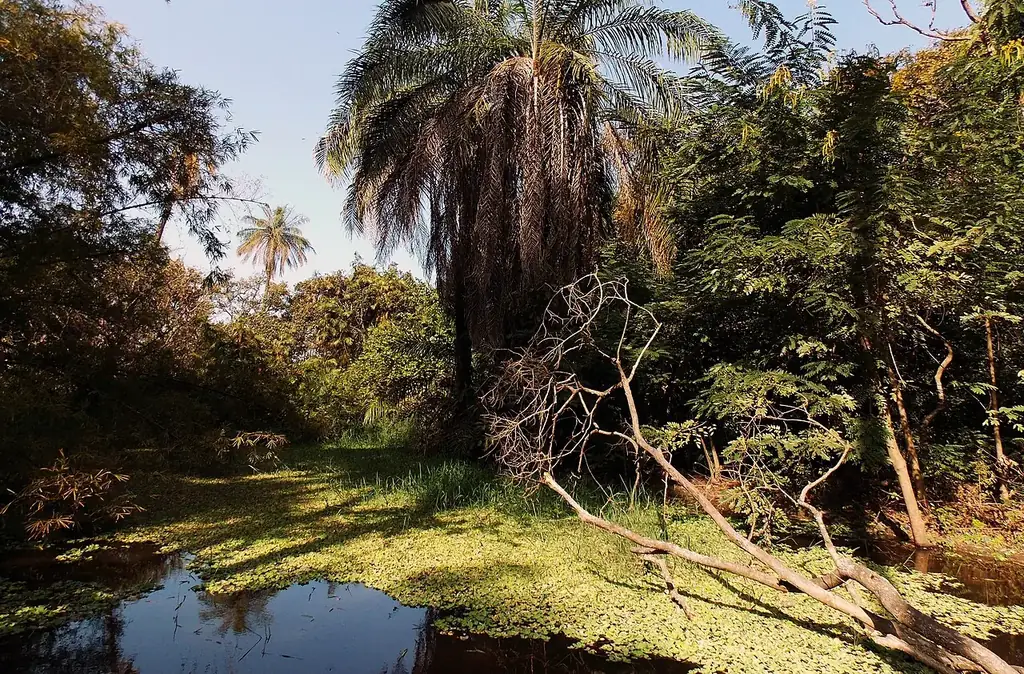 Photo: Theinfamousfinatic · CC BY-SA 3.0
Published by Adama Doumbia, founder of Afrique Unie · updated 28 November 2026 · our method and sources
- Days 1-2
Banjul and the Atlantic coast
The airport is at Yundum, about half an hour from Banjul and the beach resorts. On the first day, settle in on the coast, between Bakau, Fajara and Kotu, and slip into the country's relaxed pace. The next morning, explore Banjul, a small capital on St Mary's Island: climb to the top of Arch 22 for the view over the estuary, visit the National Museum, then wander through Albert Market. In the afternoon, stop at the Kachikally sacred crocodile pool in Bakau, then watch the fishing boats come in on the beach. Swimming is dangerous in places because of the currents, so stay close to the shore.
- Day 3
Abuko Nature Reserve and Tanji fishing village
Set off early for Abuko Nature Reserve, about twenty kilometres from the coast near Lamin, when the animals are most active. This small forest, protected since 1968, is crossed by a trail a few kilometres long that follows the Lamin stream. You will see monkeys, including red colobus and vervets, plenty of birds and, with luck, crocodiles near the pools. Allow two to three hours of gentle walking. In the afternoon, head south to Tanji, a large fishing village where fish is smoked on the beach, a striking scene when the boats return.
- Day 4
Kunta Kinteh Island, Albreda and Juffureh
Take the ferry from Banjul to Barra, on the north bank, leaving early: waits can be long and timetables irregular. From Barra, the road leads to Albreda and Juffureh, about thirty kilometres away. A dugout canoe then takes you to Kunta Kinteh Island, formerly James Island, less than four kilometres from the bank. The fort, one of the slave-trading posts on the river, is now in ruins, and the island, eaten away by erosion, is only a fraction of its original size. Together with Albreda and Juffureh, it is a World Heritage Site. Visit the small museum on the slave trade too, then return to Banjul before dark.
- Days 5-6
Up the river to Janjanbureh
On day 5, follow the south bank road east: allow five to seven hours to reach Janjanbureh, formerly Georgetown, built on MacCarthy Island and linked to the south bank by a bridge. On day 6, cross to the north bank by ferry to Lamin Koto, then drive to the Wassu stone circles, about twenty kilometres away. These standing stones, some over two metres tall, belong to the Senegambian stone circles, a World Heritage Site. A small museum explains their history. In the afternoon, take a boat trip on the river to look for birds, monkeys and sometimes hippos.
- Day 7
Back to the coast
Drive back west along the south bank road, leaving early so that you reach the coast by mid-afternoon without ever driving after dark. On the way, stop at a village market or beside a bolong, one of the mangrove-lined creeks where you can spot herons, kingfishers and sometimes dolphins near the estuary. In the evening, return to Kotu or Bakau beach for sunset. If you still have energy, Serrekunda market, the largest in the country, is worth a visit for its atmosphere and fabric stalls, but keep an eye on your belongings in the crowds.
- Day 8
Last morning and departure
Depending on your flight time, enjoy a last morning by the ocean or a walk in Bijilo Forest Park, a small coastal reserve south of Kotu where you will meet monkeys. Birdwatchers may prefer an early outing to the Tanji bird reserve on the coast. Pick up some last crafts, such as tie-dyed fabrics or carvings, then head to Yundum airport, allowing extra time for traffic, which is often heavy around Serrekunda at rush hour. If your flight leaves in the morning, save these activities for the day before.
Getting around
A car with a driver is the simplest option, especially for the trip upriver. On the coast, taxis are plentiful; agree the fare before getting in. The paved south bank road takes you to the east of the country, and ferries cross the river between Banjul and Barra and at Janjanbureh. The Farafenni bridge, on the Trans-Gambia Highway, also makes crossing easier. Avoid driving at night: unlit vehicles, animals and pedestrians are common on the roads.
When to do this trip
The best time to go is from November to May, during the dry season, with sunny weather and pleasant temperatures on the coast. Inland, the heat becomes intense from March onwards. From June to October, the rainy season makes some tracks difficult and can cause flooding, but the vegetation is lush and the birds are plentiful. The harmattan can haze the sky in December and January.
The travel notebook
The itinerary, practical information (entry, health, money, emergencies) and the checklist in a few pages, to print or keep offline on your phone.
Variations
- In 5 days: stay on the coast, with Banjul, Abuko, Tanji and Kunta Kinteh Island, without travelling upriver.
- In 12 days: spend two more nights on the river, with a boat trip between Janjanbureh and Kuntaur, then finish with a few beach days on the south coast, around Sanyang and Kartong.
- Birdwatching version: the Gambia is famous for its birds; add outings with a specialist guide at Abuko, Tanji, Kartong and the inland creeks.