 AfriqueUnie
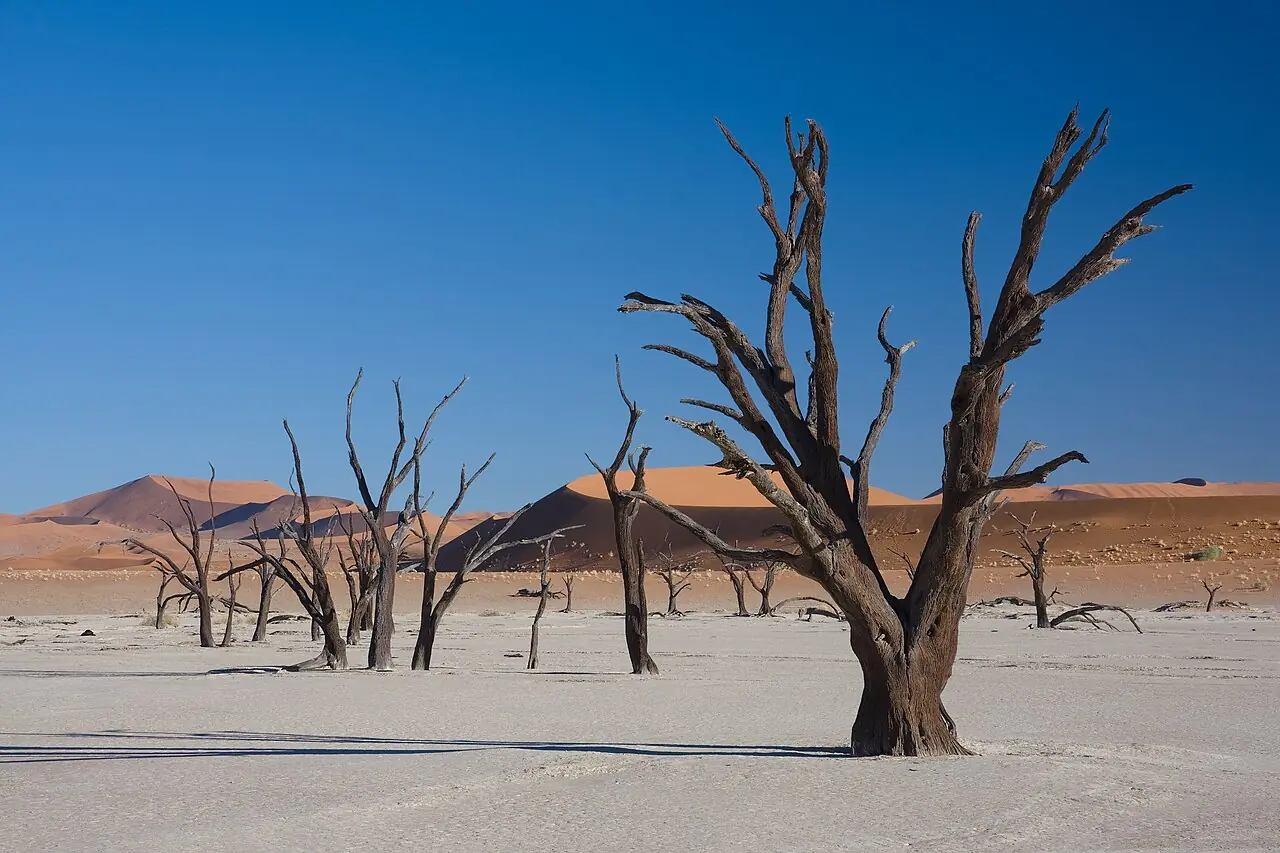 Photo: Ikiwaner · GFDL 1.2
Published by Adama Doumbia, founder of Afrique Unie · updated 28 November 2026 · our method and sources
- Day 1
Windhoek and getting to know your 4x4
The international airport is about forty-five minutes' drive east of Windhoek. Collect your vehicle and take time to check the equipment with the hire company: two spare wheels, jack, compressor and sometimes a rooftop tent and fridge. Then stock up for the first few days, with plenty of water, and withdraw some cash. In the afternoon, explore the centre of this small highland capital: the Lutheran Christuskirche, buildings from the German colonial era and the Independence Memorial Museum, whose terrace has a fine view. Have an early dinner and an early night: tomorrow's drive is a long one.
- Days 2-3
Sossusvlei and Deadvlei
Allow five to six hours on gravel heading south-west, over one of the passes that drop from the central plateau to the Namib Desert. Stay near Sesriem, ideally inside the park gate, which lets you enter before sunrise. The next morning, drive the tarred road to Dune 45, then the last few kilometres of sand, for experienced 4x4 drivers or by shuttle. A walk of about twenty minutes leads to Deadvlei, a white clay pan dotted with camel thorn trees that died centuries ago, beneath dunes more than three hundred metres high. In the afternoon, explore the small Sesriem Canyon.
- Days 4-5
Swakopmund, between desert and Atlantic
Five to six hours' drive lies ahead, via the hamlet of Solitaire, the Tropic of Capricorn sign and the Gaub and Kuiseb passes, before you reach the coast at Walvis Bay. The contrast is striking: cool fog, an icy ocean and German architecture in Swakopmund. The next day, choose from a wide range of activities: a kayak or boat trip among the seals and dolphins of Walvis Bay, a 4x4 excursion to Sandwich Harbour, where the dunes plunge into the ocean, or a guided desert tour in search of the small creatures that survive there. Make the most of it to refuel, do your laundry and eat fresh fish.
- Days 6-7
The Skeleton Coast and Damaraland
Head north along the coast on a dead-straight road between ocean and desert, often shrouded in fog. Stop at Cape Cross, home to one of the largest colonies of fur seals in the world: the noise and the smell match the spectacle. Then turn inland via Uis and the Brandberg massif, the country's highest point, to reach Damaraland. The next day, visit Twyfelfontein, listed by UNESCO for its thousands of rock engravings, then Burnt Mountain and the Organ Pipes, a cluster of basalt columns. With a local guide, head into the dry riverbeds in search of desert-adapted elephants.
- Days 8-10
Three days in Etosha
Four to five hours' drive via Khorixas and Outjo brings you to Etosha's south-western gate. The park is built around a vast white salt pan, visible from space, and wildlife gathers at waterholes spread along the roads. The method is simple: park, switch off the engine and wait. Elephants, giraffes, zebra, oryx, springbok, lions and rhinos eventually come to drink. Cross the park from west to east, sleeping in two different areas, Okaukuejo then Halali or Namutoni. Some camps have a floodlit waterhole, where black rhinos are sometimes seen at night from a bench just a few metres from the fence.
- Days 11-12
The Waterberg Plateau
Leave Etosha through the eastern gate and drive three to four hours, via Tsumeb and Otavi, to the Waterberg Plateau. This red sandstone table rises above the savannah, its vegetation greener than the surroundings thanks to springs at its base. In 1904, the site was also the scene of a decisive battle in the colonial war waged against the Herero, remembered by a cemetery. The next day, walk up to the edge of the plateau, a fairly steep climb, for the huge view over the plain. Wildlife lovers can visit a cheetah conservation centre open to the public near Otjiwarongo.
- Days 13-14
Back to Windhoek and home
Three to four hours on tarred roads separate the Waterberg from Windhoek. Stop in Okahandja, whose woodcarvers' markets sell masks, animals and everyday objects: haggle gently, as the work is often remarkable. Back in Windhoek, have the car cleaned if your contract requires it and enjoy a final dinner, often featuring game such as oryx or kudu, with a local beer brewed in the German tradition. The next day, return the vehicle at the airport with time to spare: the inspection can take a while, especially if the windscreen or tyres have suffered on the gravel. Long-haul flights usually leave in the evening or via Johannesburg.
Getting around
Hire a 4x4 or a high-clearance SUV with two spare wheels: most roads are gravel. You drive on the left. Keep to around 80 km/h on gravel, slow down in sand and on bends, and never drive at night because of wildlife. Fill up whenever you can. Book accommodation at Sesriem and Etosha early, as it is in high demand in peak season.
When to do this trip
The dry season, from May to October, is ideal: clear skies, roads in good condition and wildlife gathered at Etosha's waterholes, especially from August to October. In June and July, nights are cold, sometimes close to freezing in the desert. From November to April, the summer rains turn the country green and bring the birds, but the heat at Sossusvlei is intense. On the coast, fog is common all year.
The travel notebook
The itinerary, practical information (entry, health, money, emergencies) and the checklist in a few pages, to print or keep offline on your phone.
Variations
- In 10 days: drop the Waterberg and one night in Etosha, and drive straight back from Etosha to Windhoek, five to six hours away.
- In 18 days: add the south, with the Kalahari, Fish River Canyon, one of the largest canyons in the world, and the ghost town of Kolmanskop near Lüderitz.
- Adventure version: head north from Damaraland into Kaokoland and the Epupa Falls before entering Etosha from the west.