 AfriqueUnie
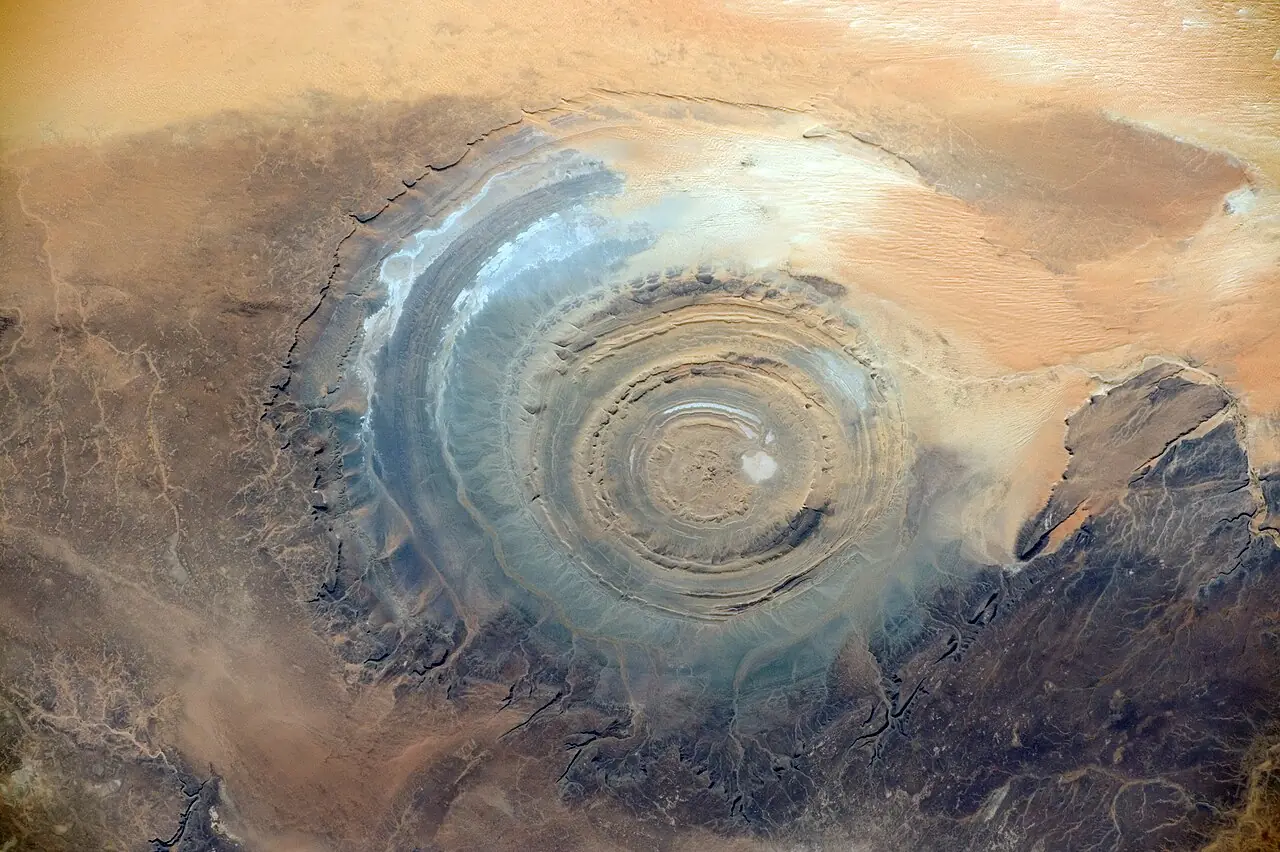 Photo: NASA · Public domain
Published by Adama Doumbia, founder of Afrique Unie · updated 28 November 2026 · our method and sources
Why go
Seen from space, it looks like a giant target laid on the Sahara: a series of concentric rings some forty kilometres across, long used by astronauts as a landmark. It is known as the Eye of the Sahara, or Guelb er Richat. Long thought to be a meteorite crater, the structure is now interpreted by geologists as an ancient dome of rock that was uplifted and then eroded over millions of years, exposing layers of rock of differing hardness.
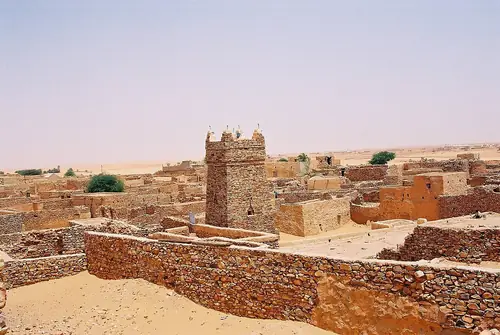
On the ground, the effect is subtler: you can't take in the circle at a single glance, but you cross a succession of rocky ridges and sandy hollows in absolute silence. It is precisely this contrast between its fame from the sky and its discretion from the ground that gives a visit its charm, often combined with the nearby ancient town of Ouadane.
Getting there
The Richat Structure lies some forty kilometres north-east of Ouadane, accessible only by 4x4 with an experienced guide, along sandy tracks. From Atar, allow a day's drive to reach Ouadane via Chinguetti. Before setting off, check the official risk maps, as this region is close to areas that are advised against.
 Algeria

 Botswana
 Chad