 AfriqueUnie
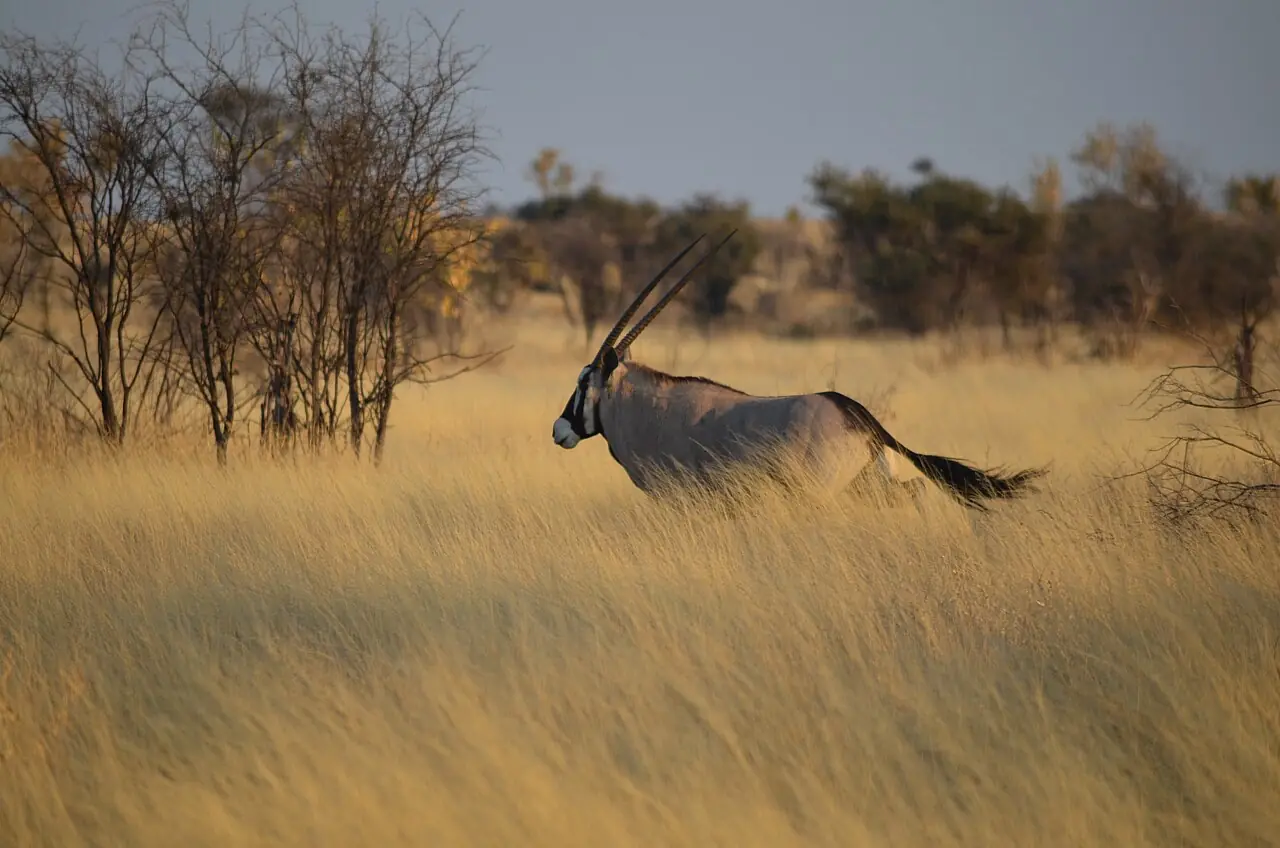 Photo: Benjamin Hollis · CC BY 2.0
Published by Adama Doumbia, founder of Afrique Unie · updated 28 November 2026 · our method and sources
Why go
In the centre of Botswana, the Central Kalahari Game Reserve has protected a vast territory of 52,800 square kilometres since 1961, almost 10% of the country's land area: it is one of the largest wildlife reserves in the world. Here the Kalahari looks nothing like a desert of bare dunes. Under an enormous sky, sandy plains covered in golden grass and thorny acacias stretch to the horizon, dotted with clay depressions, the pans, and fossil valleys where rivers once flowed. The most famous, Deception Valley, began to form around 16,000 years ago.
Despite the aridity, the wildlife is remarkably well adapted. Gemsbok, springbok, blue wildebeest, eland, red hartebeest and kudu roam the plains, followed by their predators: Kalahari lions, whose males often sport an imposing black mane, cheetahs, leopards, African wild dogs and brown hyenas. Meerkats, honey badgers, bat-eared foxes and ostriches are also seen. At the height of the rainy season, grazers gather on the fresh grass of the valleys and pans, notably around Deception Valley, and wildlife viewing reaches its peak. It was here that the zoologists Mark and Delia Owens studied lions and brown hyenas in the 1970s, an experience told in their book Cry of the Kalahari.
These lands also belong to the San, or Bushmen, hunter-gatherers who have lived here for thousands of years. From the late 1990s, most of them were moved out of the reserve to resettlement villages; in 2006, Botswana's High Court ruled the evictions unlawful and recognised their right to return, but their access remains restricted. At night, far from any light, the Kalahari sky is among the starriest in Africa, and the silence is broken only by the distant roar of a lion or the call of a jackal.
Getting there
The reserve lies in the centre of Botswana. The most used entrance, Matswere Gate, is in the north-east near the village of Rakops, a day's drive on tar and track from Maun; in the west, Tsau Gate is reached from Ghanzi. To the south, the reserve continues without fences into Khutse Game Reserve, about 240 kilometres from Gaborone. The deep-sand tracks require a well-equipped 4x4, and there is no water, fuel or supplies inside. Private camps inside the reserve or on its edge are often reached by light aircraft from Maun.
Frequently asked questions
When is the best time to visit the Central Kalahari Game Reserve?
During the rainy season, roughly from December to April, the plains turn green and antelope gather in valleys such as Deception Valley, drawing predators: this is the best time for wildlife, but it is very hot and afternoon thunderstorms are common. From May to October, the dry season brings milder days and cold nights, with animals more widely dispersed.
Do you need a 4x4 for the Central Kalahari?
Yes, a well-equipped 4x4 is essential: the tracks are deep sand and there are no services inside the reserve. Bring water, fuel and food for the whole stay, recovery gear and a satellite communication device. If you lack this experience, choose a guided safari or a fly-in camp.
Can you see black-maned lions in the Central Kalahari?
Yes, Kalahari lions are one of the reserve's great attractions, and many males carry an impressive dark mane. They live at low density over large territories, so sightings are never guaranteed, but they are more frequent in the rainy season, around the valleys where antelope gather.
Can you meet the San in the Central Kalahari?
Most San have been moved out of the reserve since the late 1990s, despite a 2006 court ruling recognising their right to live there. Some camps and villages in the region offer walks with San guides, who explain gathering, tracking and desert plants. Favour initiatives run by the communities themselves and respect their choice whether or not to be photographed.
How many days should you spend in the Central Kalahari Game Reserve?
Allow at least three nights, as distances are long and driving in sand is slow. Four to five nights let you combine Deception Valley with more remote areas, or continue south into Khutse Game Reserve. The Makgadikgadi Pans, to the east, round off a Kalahari itinerary nicely.
 Namibia
 Algeria
 Chad