AfriqueUnie
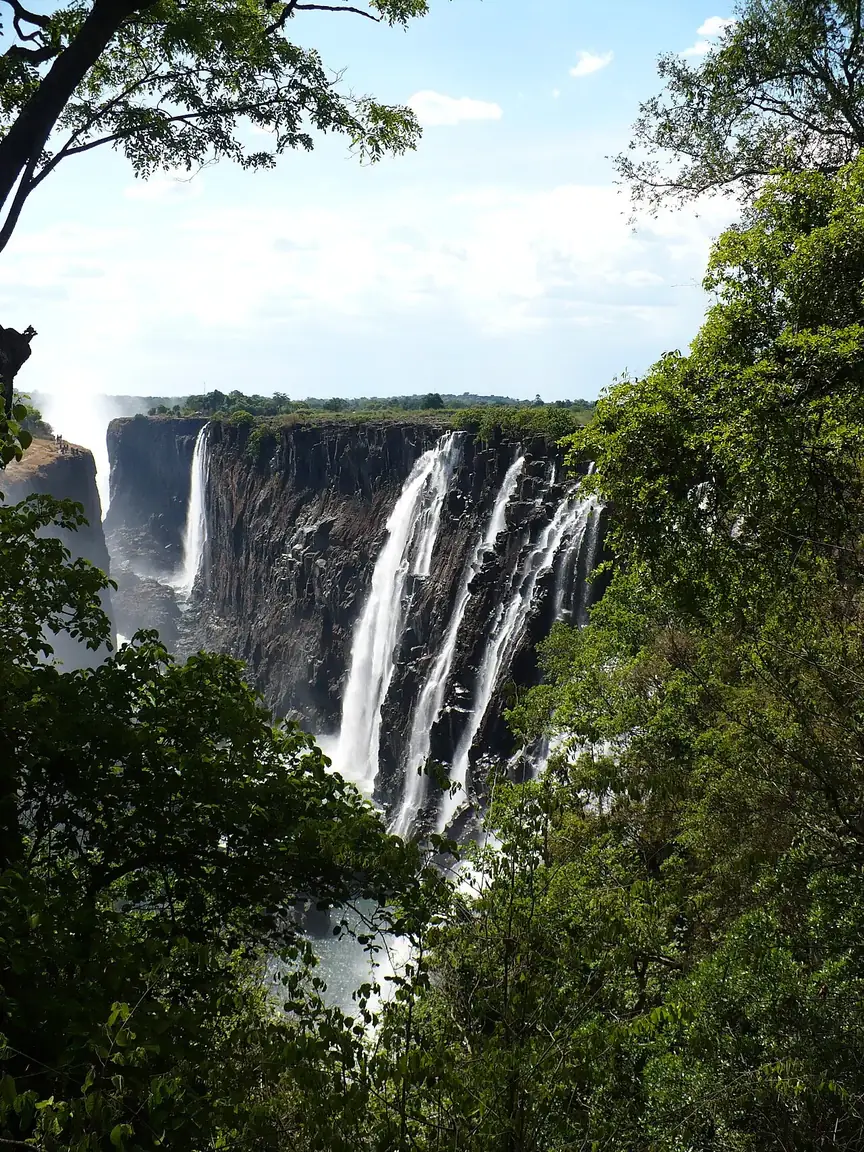 Photo: Florence Devouard · CC BY-SA 4.0
Published by Adama Doumbia, founder of Afrique Unie · updated 28 November 2026 · our method and sources
Why go
Local people called them Mosi-oa-Tunya, “the smoke that thunders”. Here the Zambezi, almost 1.7 kilometres wide, plunges all at once into a narrow chasm more than 100 metres deep. The resulting cloud of spray rises so high that it can be seen tens of kilometres away, and the roar accompanies you long before you catch sight of the water. David Livingstone, the first European to describe them, in 1855, named them after Queen Victoria.
On the Zimbabwean side, a well-laid path runs the full length of the opposite cliff, through a rainforest permanently fed by the spray and alive with monkeys and birds. Some fifteen viewpoints follow one after another, offering the most complete head-on view of the falls. In the high-water season you walk through a driving downpour and can barely make out the curtain of water; in the dry season the rock is revealed and you grasp the sheer power of erosion. On full-moon nights, a lunar rainbow can form in the cloud of spray.
Getting there
The entrance to the site is a few minutes' walk from the centre of Victoria Falls town. The town's international airport is about twenty kilometres away. From Livingstone, in Zambia, you reach the Zimbabwean side by crossing the Victoria Falls Bridge on foot or by taxi, after border formalities. From Kasane, in Botswana, a day trip is common.
Frequently asked questions
Should you see Victoria Falls from Zimbabwe or Zambia?
The Zimbabwean side offers the fullest face-on view, taking in most of the curtain of water. The Zambian side lets you get closer to the edge and see the falls from a different angle, especially when the water is high. If you have time, visit both: the bridge between them can be crossed on foot. On the Zambian side, France's foreign ministry urges vigilance between Livingstone town and the falls, where tourists have been assaulted, although the site itself is secure.
When is the best time to see Victoria Falls?
It depends on what you are after. From February to May the flow is at its peak and the spectacle is immense, but the spray often hides the view and drenches visitors. From August to December the water drops, the view is clearer and parts of the Zambian side can almost run dry late in the season.
Can you swim in the Devil's Pool?
Yes, but only on the Zambian side, on a guided trip to Livingstone Island, and only when the Zambezi is low enough, generally from around mid-August to December or January. Places are limited, so book ahead. Exact dates vary each year with the river level.
Do you need a visa to visit both sides of Victoria Falls?
Nationals of many countries need a visa for both Zimbabwe and Zambia. The KAZA UniVisa, when available, covers both countries and lets you cross the bridge as often as you like. Check the current entry requirements for your nationality before you travel.
Can you see the lunar rainbow at Victoria Falls?
Yes, on full-moon nights a lunar rainbow can form in the spray, especially in the high-water season, roughly February to August. The site then opens specially in the evening around the full moon. A clear sky is essential, and the bow shows up more strongly in long-exposure photographs than to the naked eye.
 Lesotho
 Namibia
 South Africa