 AfriqueUnie
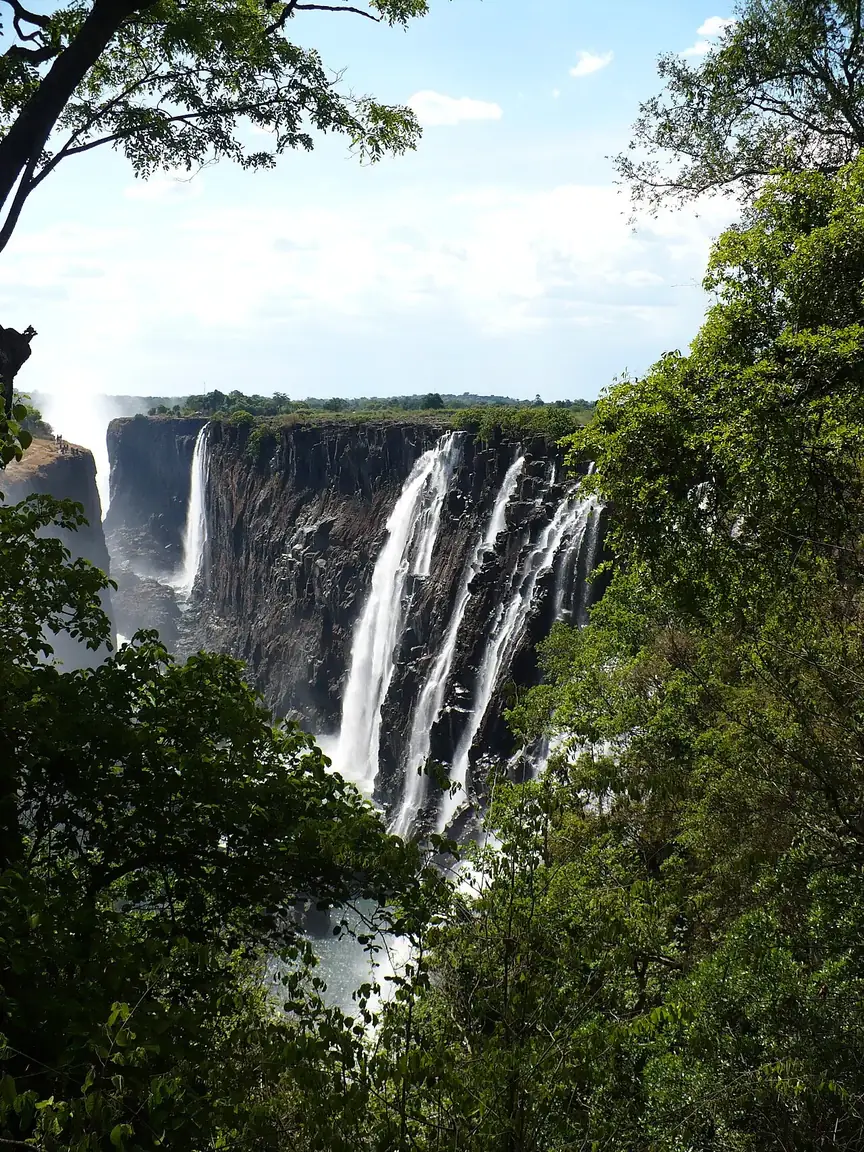 Photo: Florence Devouard · CC BY-SA 4.0
Published by Adama Doumbia, founder of Afrique Unie · updated 28 November 2026 · our method and sources
- Days 1-2
Victoria Falls
Victoria Falls airport is well served from Johannesburg and several African capitals, and the small town is about twenty minutes away. On the first day, walk the rainforest trail of the falls park on the Zimbabwean side, which follows the cliff facing the cataract for nearly two kilometres: from here you see most of the curtain of water, and a raincoat is essential at high water. Come back late in the day if you can, or at full moon, when the park sometimes opens to view the lunar rainbow. In the evening, board a sunset cruise on the Zambezi, among hippos and elephants.
- Day 3
The Zambezi gorges and the bridge
Spend a day around the falls. In the morning, choose between a helicopter flight, which reveals the zigzag succession of gorges cut by the river, or rafting through those gorges, possible mainly in the dry season, when the water drops. Then walk onto the Victoria Falls Bridge, built in the early twentieth century, which links Zimbabwe with Zambia high above the river. In the afternoon, browse the town's craft market for stone and wood carvings, or cross to the Zambian side to see the falls from another angle, as long as you have the right visa.
- Days 4-6
The elephants of Hwange National Park
Allow two and a half to three hours' drive south-east to the main entrance of Hwange National Park, the largest in the country. This land of savannah and teak forest is home to tens of thousands of elephants, which gather at the end of the dry season around waterholes fed by pumps. Go on game drives at dawn and late in the day, and spend a few hours in the hides set up near the water, where elephants, buffalo, zebras and antelopes come and go. With some luck, you will see lions, wild dogs or hyenas. Private lodges and camps on the park's edge offer guided walks and night drives.
- Days 7-8
Bulawayo and the Matobo Hills
About four hours' drive takes you from Hwange to Bulawayo, the country's second city, with wide avenues lined with colonial buildings. Visit the Natural History Museum, one of the richest on the continent, and the city market. The next day, head to the Matobo Hills, less than an hour south and listed by UNESCO: balancing granite boulders, caves decorated with San rock paintings and the viewpoint of World's View. The park is also home to rhinos, which can be tracked on foot with a licensed guide. It is one of the most memorable stops of the trip, so do not cut it short.
- Days 9-10
The ruins of Great Zimbabwe
Allow about four hours' drive to Masvingo, then half an hour to the site of Great Zimbabwe. This dry-stone city, built between the eleventh and fifteenth centuries, was the capital of a kingdom that traded as far as China; it gave the country its name. Climb to the Hill Complex, perched on a rocky outcrop, then walk down to the Great Enclosure, with its curving wall and conical tower. The small museum displays the famous soapstone birds, now the national emblem. Hire a guide on site. The next day, drive around nearby Lake Mutirikwi or take a morning walk in the neighbouring reserve.
- Days 11-12
Harare, then home
About four hours' drive north takes you to Harare, the capital, a green city with avenues lined with jacarandas, which bloom purple in September and October. Visit the National Gallery, which exhibits world-renowned Shona sculpture, then the Chapungu sculpture garden or an artists' workshop on the outskirts. The lively Mbare market is best visited with a local guide. On the last day, depending on your flight time, enjoy lunch in one of the restaurants in Avondale or Borrowdale before heading to the airport, about twenty minutes from the centre outside rush hour.
Getting around
The main roads, from Victoria Falls to Harare, are tarred but sometimes damaged. A car with a driver or a self-drive rental are both possible; traffic drives on the left. Do not drive at night, because of animals and unlit vehicles, and expect regular police checkpoints. Domestic flights link Victoria Falls, Bulawayo and Harare. The US dollar circulates widely alongside the local currency, and fuel and cash shortages have been frequent in recent years: check the situation before you leave.
When to do this trip
The dry season, from May to October, is the best for safaris in Hwange, with animals gathering around waterholes in the very hot months of September and October. Victoria Falls is at peak flow from March to May, and lower at the end of the year. The rainy season, from November to March, turns the landscape green, but some tracks become difficult. Nights can be cold in June and July.
The travel notebook
The itinerary, practical information (entry, health, money, emergencies) and the checklist in a few pages, to print or keep offline on your phone.
Variations
- In 7 days: keep Victoria Falls and Hwange, then fly home from Victoria Falls.
- In 15 days: add Mana Pools National Park, reached by light aircraft, for walking and canoe safaris on the Zambezi, or a houseboat trip on Lake Kariba.
- Mountain version: finish in the Eastern Highlands, Nyanga and Chimanimani, for hiking, waterfalls and cooler air.