 AfriqueUnie
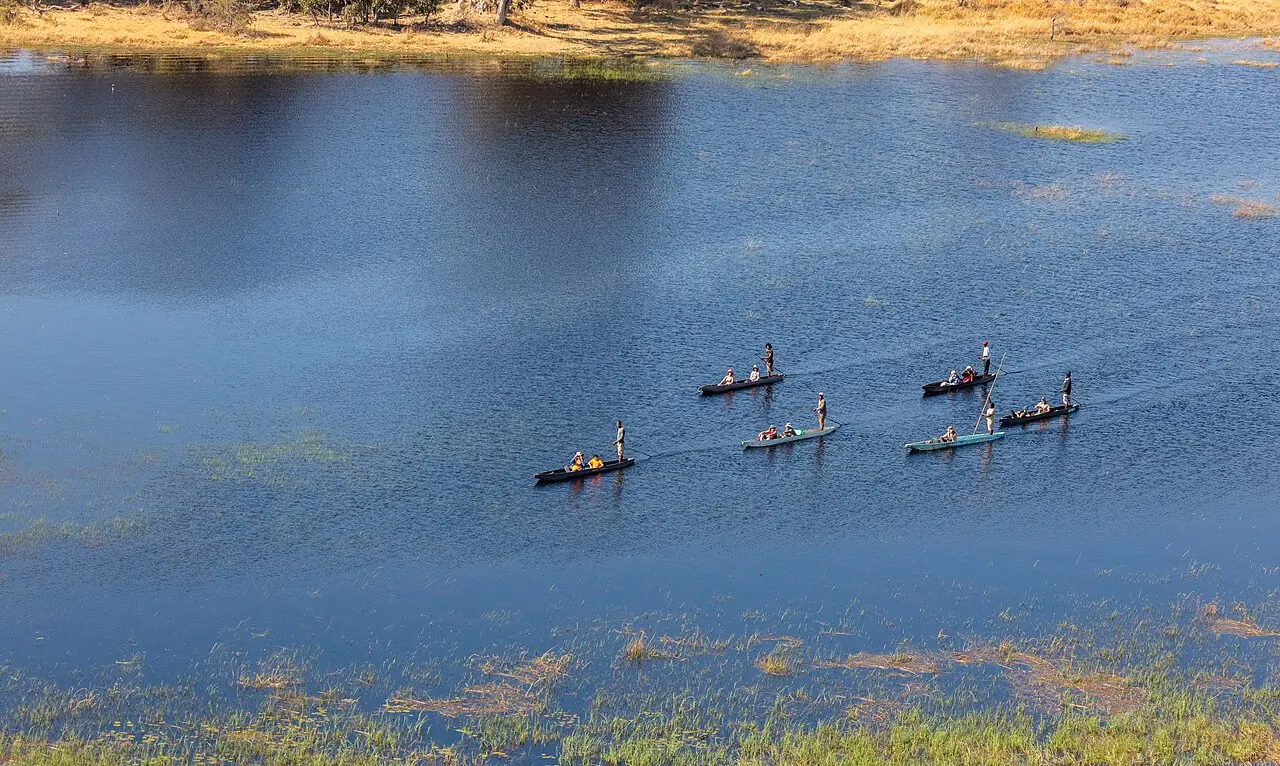 Photo: Diego Delso · CC BY-SA 4.0
Published by Adama Doumbia, founder of Afrique Unie · updated 28 November 2026 · our method and sources
- Day 1
Maun, gateway to the delta
Most travellers arrive in Maun on a flight from Johannesburg or Cape Town. This small, dusty town on the Thamalakane River is not a destination in itself, but it is the starting point for every trip into the delta. Use the afternoon for a scenic flight over the delta by light aircraft or helicopter: from the air, the maze of channels, islands and lagoons makes sense, and you can spot elephants and buffalo. If you are hiring a 4x4, stock up here on fuel, water and supplies. In the evening, have dinner by the river and double-check the details of the next day's transfers.
- Days 2-4
The Okavango Delta by mokoro
The delta is usually reached by light aircraft, to a camp on an island or in a private concession, or by road and boat for simpler options. The mokoro, a traditional dugout canoe pushed by a pole, glides silently between papyrus and water lilies: it is the best way to take in the stillness of the delta and watch reed frogs, kingfishers and elephants crossing the channels. Guided walks on the islands let you approach wildlife on foot, with care. Camps also offer game drives. Water levels vary through the year: check which activities are possible on your dates.
- Days 5-6
Moremi Game Reserve and the Khwai concession
East of the delta, Moremi Game Reserve combines mopane woodland, floodplains and lagoons, with one of the best concentrations of wildlife in the country: lions, leopards, wild dogs, hippos and lechwe. Allow three to four hours of sandy track from Maun by 4x4, or a short flight to a camp. Right next door, the community-run Khwai concession allows night drives and walks, which are not permitted inside the reserve. Set out at dawn, when predators are active. If you are driving yourself, book campsites well in advance, as they are in high demand, and never ignore the rules: the campsites are unfenced.
- Days 7-8
The salt pans of Makgadikgadi
Head back to Maun, then two and a half hours' drive east to the Makgadikgadi Pans, ancient lakes turned into vast expanses of salt. In the dry season, you can meet habituated meerkats, which sometimes climb onto visitors to scan the horizon, and sleep under the stars on the salt with an organised camp. In the rainy season, the nearby plains of Nxai Pan National Park and the Boteti River host a zebra migration. Do not miss Baines' Baobabs, a group of ancient trees on the edge of a pan. Never venture onto the salt alone: the crust can give way under a vehicle.
- Days 9-11
Kasane, Chobe National Park and Victoria Falls
Allow five hours' drive via Nata to Kasane, watching out for elephants crossing the road. Chobe National Park has one of the largest elephant populations in Africa: at the end of the dry season, hundreds come down to drink at the river. Alternate game drives along the riverfront with late-afternoon boat cruises among hippos, buffalo and crocodiles at sunset. On the third day, make the trip to Victoria Falls, on the Zimbabwean side, about an hour and a quarter by road via the Kazungula border post. Check the visas you need in advance and carry your passport.
- Day 12
Departure from Kasane
Depending on your flight, enjoy a last cruise or early-morning game drive on the Chobe River before heading to Kasane airport, which has flights to Johannesburg and Maun. Another option is to fly out of Victoria Falls airport, on the Zimbabwean side, which has more connections and is about an hour and a half away by road including the border crossing: leave a comfortable margin. If you are returning a 4x4 hired in Maun, ask about one-way fees to Kasane, which are often high. Use your last hours to buy traditional basketry, a speciality of the north of the country.
Getting around
There are two approaches. Delta camps and many lodges are reached by light aircraft, with luggage limited to a soft bag of a few kilos. The other option is a self-drive trip in an equipped 4x4 with a rooftop tent, for experienced travellers: the tracks in Moremi and Chobe are sandy and the campsites unfenced. Traffic drives on the left, and driving at night should be avoided because of animals on the road. The tarred roads between Maun, Nata and Kasane are good, but long and monotonous.
When to do this trip
The dry season, from May to October, is the best for safaris: vegetation thins out and animals gather around water. Paradoxically, the delta's floods, fed by rains in Angola, peak between June and August. September and October are very hot. The rainy season, from November to April, is the green season: storms and difficult tracks, but newborn animals, migratory birds and the zebra migration in Makgadikgadi.
The travel notebook
The itinerary, practical information (entry, health, money, emergencies) and the checklist in a few pages, to print or keep offline on your phone.
Variations
- In 8 days: keep three nights in the delta, by light aircraft, then three nights in Chobe with the trip to Victoria Falls.
- In 15 days: add the Central Kalahari Game Reserve for its black-maned lions, or the Tsodilo Hills and their rock paintings, west of the delta.
- Self-drive version: hire an equipped 4x4 in Maun and cross from Maun to Moremi, Savuti and Chobe on the tracks, booking campsites months in advance.