 AfriqueUnie
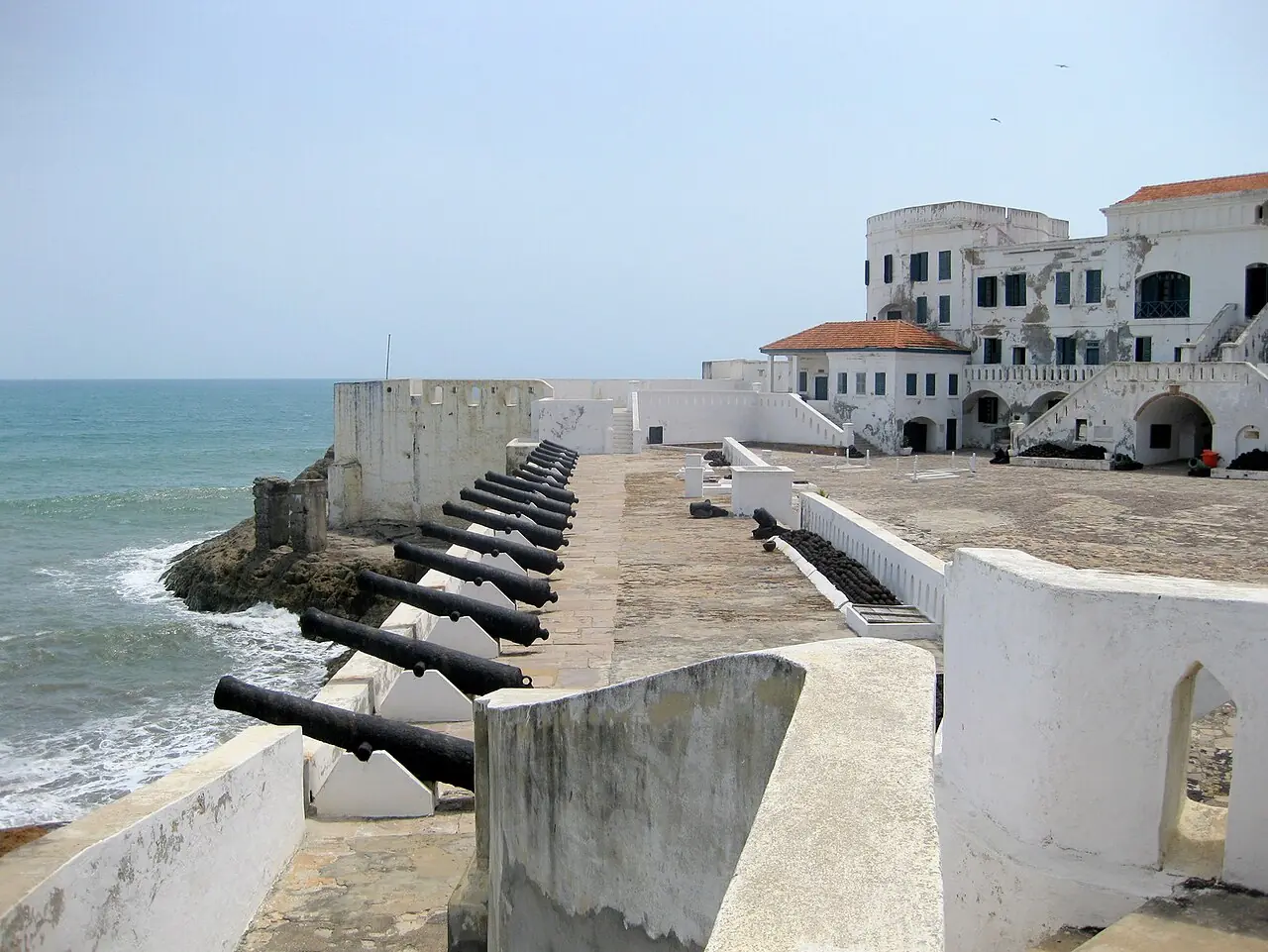 Photo: Rjruiziii · CC BY-SA 3.0
Published by Adama Doumbia, founder of Afrique Unie · updated 28 November 2026 · our method and sources
- Days 1-2
Accra, capital of Ghana
Accra is a big, sprawling, hot and traffic-choked city that is best explored district by district. After landing at Accra International Airport, very close to the centre, take time to rest. On day 2, start with the Kwame Nkrumah Memorial Park, dedicated to the father of independence, then Independence Square and its Black Star arch. Continue to Makola Market, huge and crowded, where you keep your bag in front of you. In the afternoon, visit the old fishing district of Jamestown with a local guide, for its lighthouse and colonial houses, but in daylight only: French official advice recommends not moving around there at night. In the evening, the main street of Osu is lined with restaurants and bars; get around by taxi or by app-booked car.
- Days 3-4
Cape Coast, Elmina and the Kakum canopy
About 150 kilometres separate Accra from Cape Coast, to the west: allow three hours, more if you leave the capital at rush hour. In the afternoon, visit Cape Coast Castle, whose dungeons and Door of No Return tell the story of the Atlantic slave trade; the guided tour is harrowing and essential. The next day, leave early for Kakum National Park, about thirty kilometres to the north: a suspended walkway of seven bridges crosses the canopy, up to some forty metres above the ground. Arrive at opening time to avoid the groups. In the afternoon, head to Elmina, about fifteen kilometres from Cape Coast: its castle, founded by the Portuguese in 1482, overlooks a very lively fishing harbour. The forts of the Ghanaian coast are a World Heritage Site.
- Day 5
Back to Accra along the coast of forts
The road back follows a coast dotted with more modest forts, built by Europeans in the 17th and 18th centuries. Stop at one of them, for example in Anomabo or Abandze, where a small fort perched above the fishing canoes gives a fine view over the bay. The beaches are superb, but swimming is dangerous all along the Ghanaian coast because of currents and breakers, and official advice recommends avoiding isolated beaches. Reach Accra in mid-afternoon, before the evening traffic jams. Use the evening to gather your documents: passport, printed visas for Togo and Benin, yellow fever vaccination certificate, and a few CFA francs if you can find some.
- Day 6
From Accra to Lomé via the Aflao border post
Leave early: about 190 kilometres, or three and a half to four hours on the road, lead to Aflao, the last town in Ghana, crossing the Volta by the Sogakope bridge. The Aflao border post, open around the clock according to French official advice, opens straight into Lomé, whose centre is only a few kilometres away. Formalities are done on foot: exit from Ghana, then entry into Togo with the e-visa obtained in advance, as Togo no longer issues visas on arrival. Cross in the middle of the day, keep your passport and luggage close, ignore the touts and do not linger: the French authorities advise against strolling near the border and along the Lomé seafront, especially in the evening. Take a taxi to your accommodation.
- Day 7
Lomé, markets and fetishes
Lomé is a capital on a scale that is easy to grasp. In the morning, the Grand Marché spreads around the Sacred Heart Cathedral: this is the realm of the cloth traders, the famous Nana Benz, who made printed wax cloth famous across the region. Then see the Independence Monument and the National Museum, modest but useful for understanding the peoples of the country. In the afternoon, take a taxi to the Akodessewa fetish market, where healers and vodun followers come for supplies; a guide explains the use of the objects on display, and you should ask before taking photographs. As in Accra, travel by taxi once night falls, and avoid the beach, which is unsafe even in daytime.
- Day 8
Lake Togo, Togoville and Aného
The coast road leads in under an hour to Agbodrafo, about 35 kilometres from Lomé, on the shore of Lake Togo. From there, a pirogue crosses the lagoon to Togoville, on the northern shore: the village, where the protectorate treaty with Germany was signed in 1884, combines a cathedral built by German missionaries with numerous vodun shrines. A village guide accompanies the visit. Back in Agbodrafo, see the Slave House, a discreet residence linked to the clandestine slave trade of the 19th century. Continue to Aného, about ten kilometres further on: the former capital of Togo, the town still has faded colonial buildings, between the ocean and the lagoon. It is a quiet stop, a few kilometres from the Benin border.
- Day 9
Into Benin via Hillacondji, then Grand-Popo
The border post of Sanvee Condji, on the Togolese side, and Hillacondji, on the Beninese side, lies a few kilometres east of Aného, on the coast road. Cross in the morning, with your printed Beninese e-visa and your yellow fever vaccination certificate; the currency remains the CFA franc. According to the British authorities, you cannot obtain visas for Togo or Ghana in Benin: if you plan to retrace your steps, you need multiple-entry visas. About twenty kilometres further on, Grand-Popo stretches between the ocean and the Mono River. In the afternoon, a pirogue trip leads through the mangroves to the Bouche du Roy, where the river meets the sea. Swimming in the sea is advised against all along the Beninese coast.
- Days 10-11
Ouidah, memory of the slave trade and vodun
Ouidah is only about forty kilometres from Grand-Popo, an hour by road. Once a major slave port of the Gulf of Guinea, the town can be visited over two unhurried days. First follow the Slave Route, a track of about four kilometres lined with statues and memorials, which leads from the centre to the beach and the Door of No Return; walk it in the morning, or go by car with a guide. In town, see the Temple of Pythons, opposite the basilica, the Sacred Forest of Kpassè and its statues of deities, and the old Portuguese fort, whose museum has undergone lengthy works: check locally what is open. Around 10 January, the vodun festival draws very large crowds: book a long time ahead.
- Day 12
Abomey, capital of the kings of Dahomey
Allow two and a half to three hours on the road, via Allada and Bohicon, to cover the 120 kilometres or so between Ouidah and Abomey. From the 17th to the 19th century, twelve kings of Dahomey built their earthen palaces here, now a World Heritage Site. Those of kings Ghézo and Glèlè house the historical museum, with its thrones, hangings and coloured bas-reliefs recounting the kingdom's victories and the role of its women soldiers, the Agojie. The site is undergoing a major programme of renovation and construction of a new museum: ask before you come which parts are accessible. A local guide can also show you the craft workshops and the other palaces scattered around the town. Abomey is in the south of the country, under heightened vigilance.
- Days 13-14
Ganvie and Cotonou
Head back south: about 130 kilometres, or three hours, to Abomey-Calavi, on the edge of Cotonou. From its jetty, a pirogue takes you to Ganvie, a large village built on stilts in the middle of Lake Nokoué, where everything happens on the water: floating market, school, fishing in enclosures made of branches. Ask residents for permission before photographing them. Sleep in Cotonou. On the last day, see Amazon Square and its monumental statue, the murals of the long painted wall near the port and the craft promotion centre for last purchases. At Dantokpa market, watch your belongings. The French authorities consider the city's beaches unsafe. Cotonou airport, right in the city, is a taxi ride away for your flight home.
Getting around
The simplest option is a car with a driver in each country, booked through your accommodation or a local agency, changing vehicles at the borders, which you cross on foot: taking a hire car from one country to another is complicated. Shared taxis and minibuses link all the towns along the coast more cheaply, but they are often overloaded; the British authorities in particular advise against taxis and long-distance buses in Benin. The coast road is tarred from end to end. Do not drive at night, and book a flight arriving in Accra and returning from Cotonou.
When to do this trip
The best time is from November to February, during the main dry season shared by all three countries; in Ghana it lasts until March. It is hot, tracks are passable and the sky is sometimes hazy with the harmattan, a dust-laden wind from the Sahara, especially in December and January. On the coast, the rains fall in two seasons, from about April to July, then in September and October: storms are violent but brief, and some streets flood in Accra and Cotonou. August, drier and less hot, is an acceptable fallback.
The travel notebook
The itinerary, practical information (entry, health, money, emergencies) and the checklist in a few pages, to print or keep offline on your phone.
Variations
- In 10 days: drop either the return trip to Cape Coast or Abomey, and keep two nights in Accra, two in Lomé, one in Aného, two in Ouidah and two in Cotonou.
- In 16 days: add two nights in Kpalimé, in the hills of south-western Togo, from Lomé, or a day in Porto-Novo, the capital of Benin, from Cotonou.
- As a loop: if your flight home leaves from Accra, return from Cotonou on a regional flight or by road over two days, with multiple-entry visas for Togo and Ghana.