 AfriqueUnie
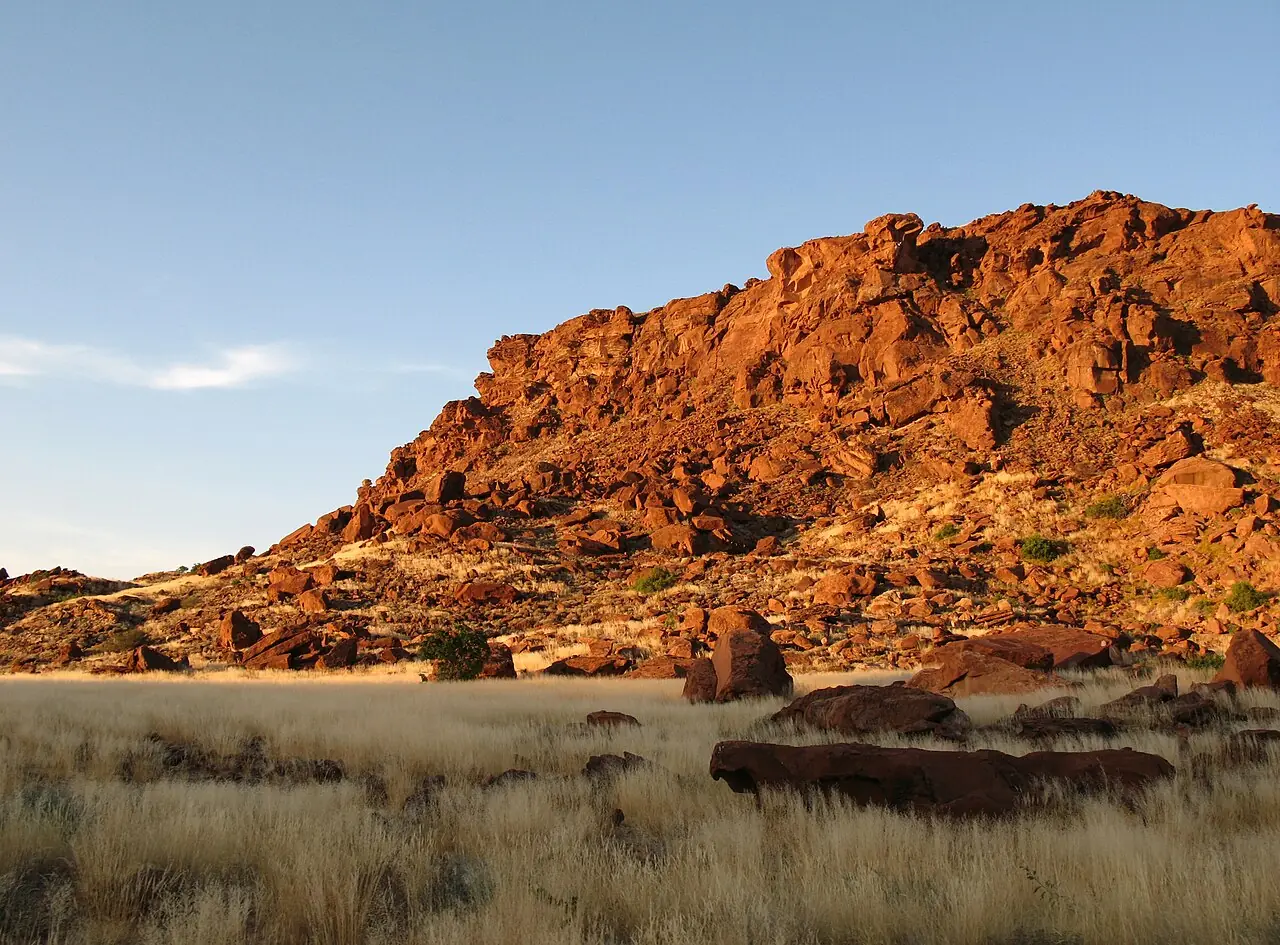 Photo: V. Epiney · CC BY-SA 2.0
Published by Adama Doumbia, founder of Afrique Unie · updated 28 November 2026 · our method and sources
Why go
In north-western Namibia, Damaraland unfolds landscapes of raw, mineral beauty: lava plateaus, red mountains, plains dotted with euphorbias and dry riverbeds. At its heart, the Twyfelfontein valley, /Ui-//aes in the Damara language, holds one of Africa's largest concentrations of rock engravings, with more than two thousand figures carved into the sandstone by hunter-gatherers over several millennia. In 2007 it became Namibia's first UNESCO World Heritage Site.
A guided trail leads among boulders engraved with giraffes, rhinos, ostriches, animal tracks and geometric patterns; the most famous, the "Lion Man", has a tail ending in a hand. Nearby you can see the basalt Organ Pipes, Burnt Mountain and a petrified forest with trunks several hundred million years old. Along seasonal rivers such as the Aba-Huab and the Huab live desert-adapted elephants, which you can track with local guides. Further south, the Brandberg, the country's highest mountain, hides the famous "White Lady" painting.
Getting there
Twyfelfontein is about a day's drive from Windhoek and four or five hours from Swakopmund, largely on well-maintained gravel roads. The region is explored on a self-drive trip, often as a stop between the coast and Etosha National Park. A high-clearance vehicle is enough for the main roads; a 4x4 is recommended for secondary tracks. Several lodges and campsites nestle in the nearby valleys.
Frequently asked questions
Do you need a guide to see the Twyfelfontein engravings?
Yes, the engravings can only be visited with a site guide, and the walk takes about an hour. The trail winds between sandstone boulders and rocks that can be slippery, so wear closed shoes. Come early in the morning, as the heat on the rocks soon becomes overwhelming.
Why is Twyfelfontein a World Heritage Site?
Because it holds one of the largest concentrations of rock engravings in Africa, with more than two thousand figures. In 2007 it became Namibia's first UNESCO World Heritage Site. The engravings, made over several thousand years, reflect the rituals of hunter-gatherers and later of Khoikhoi herders.
Can you see desert elephants in Damaraland?
Yes, desert-adapted elephants live along seasonal rivers such as the Aba-Huab and the Huab, but sightings are never guaranteed. Always go with a local guide, who knows where to look and how close to get. Never approach them on foot.
How do you get to Twyfelfontein?
Allow a day's drive from Windhoek, or four to five hours from Swakopmund, mostly on gravel roads. The site lies south of the C39, west of Khorixas, along a minor road. A high-clearance vehicle is fine for the main roads, and a 4x4 is recommended for minor tracks.
What is there to see around Twyfelfontein?
The Organ Pipes and Burnt Mountain are close by, and a petrified forest lies on the road to Khorixas. Further south, the Brandberg, the country's highest mountain, shelters the famous White Lady rock painting. The area sits naturally between the coast and Etosha National Park.
 Botswana
 Lesotho
 Mozambique
 South Africa