 AfriqueUnie
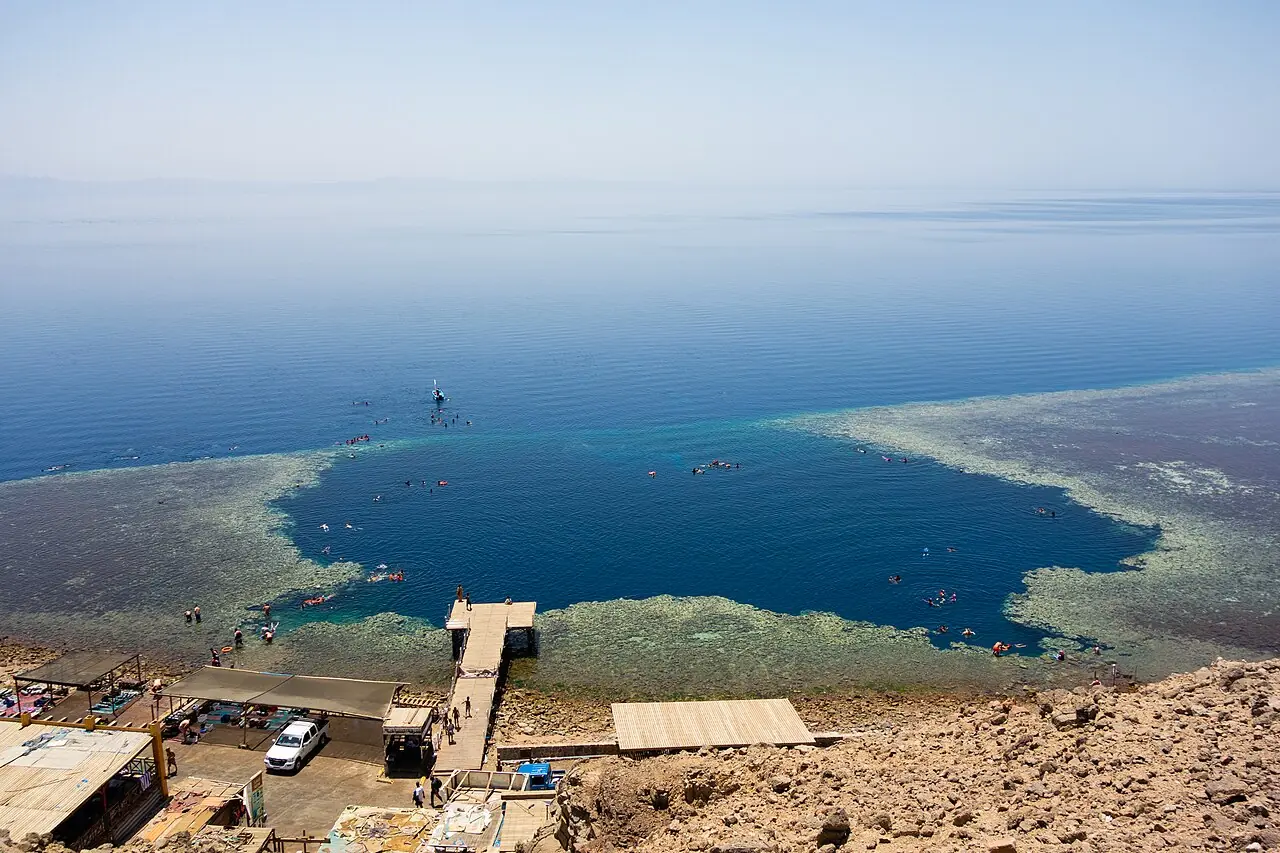 Photo: Petar Milošević · CC BY-SA 4.0
Published by Adama Doumbia, founder of Afrique Unie · updated 28 November 2026 · our method and sources
Why go
A few kilometres north of Dahab, on the east coast of the Sinai, the reef suddenly breaks off to make way for a circle of deep blue: this is the Blue Hole, an underwater sinkhole about 100 metres deep at the foot of the mountains, on the shore of the Gulf of Aqaba. Seen from the cliff, the contrast between the pale coral fringing the hole and the almost black blue at its centre is striking. On land, barren brown mountains drop straight into the sea, and a row of beach cafés lines the shore facing the reef.
The Blue Hole is above all a snorkelling paradise. Along its rim, the coral wall teems with life a few metres below the surface: parrotfish, butterflyfish, angelfish, groupers and shoals of small silvery fish, against a backdrop of hard and soft corals. A shallow opening, “the Saddle”, about six metres below the surface, links the hole to the open sea. Experienced scuba divers usually follow the famous “Bells” route, a narrow crack that drops down the wall before reaching the Blue Hole over the Saddle.
The site also owes its reputation to a darker side. At the bottom, a 26-metre-long underwater arch, whose ceiling lies 55 metres down, connects the hole to the open sea, where the seabed plunges to several hundred metres. This depth is far beyond the limits of recreational diving, and poorly prepared attempts have cost many divers their lives: estimates vary, but dozens of deaths are documented and some sources put the total close to 200. Memorial plaques on the cliff facing the hole recall these tragedies. For swimmers and divers who stay within their limits, however, the Blue Hole is a spectacular and accessible site.
Getting there
The Blue Hole lies a few kilometres north of central Dahab, at the end of a road that runs along the coast; get there by taxi, on a tour or with a dive centre, in around fifteen minutes from the centre. Dahab is about 80 kilometres north-east of Sharm el-Sheikh, whose international airport receives direct flights from Europe. According to GOV.UK, British travellers arriving by air at Sharm el-Sheikh for less than fifteen days at the resorts of Sharm el-Sheikh, Dahab, Nuweiba or Taba can get a free Sinai-only entry stamp: check the conditions for your nationality. Avoid North Sinai, which is strongly advised against, and the interior of the peninsula north of the St Catherine–Nuweiba road, where the UK advises against all but essential travel.
Frequently asked questions
Is the Blue Hole in Dahab dangerous?
For snorkelling and recreational diving within your level, the Blue Hole is no more dangerous than other Red Sea sites. The danger lies in the underwater arch, whose ceiling is 55 metres down: many divers have died trying to pass through it without technical training or suitable gas. Dive with a certified guide and never exceed your limits.
Can you snorkel at the Blue Hole without being a diver?
Yes. The rim of the hole is one of the best snorkelling sites in the Red Sea, with a rich reef in shallow water. You just need to be a confident swimmer, wear a buoyancy vest if you are not at ease, and get in at the designated entry points so as not to trample the coral. Avoid drifting out towards the open sea, where currents and passing boats are more dangerous.
What level do you need to dive the Blue Hole?
The classic Bells to Blue Hole route goes down to around thirty metres, so local dive centres reserve it for advanced divers, such as Advanced Open Water or equivalent. Beginners can try a discovery dive or a shallow dive over the Saddle. Going through the arch requires a deep technical diving certification.
When should you go to the Blue Hole in Dahab?
You can swim there all year round. The water is warmest from summer to autumn, while in winter a thicker wetsuit is useful and the wind can feel cool. Spring and autumn offer a good balance between air temperature, water temperature and crowds. In summer, the heat is intense, so protect yourself from the sun.
How do you get to the Blue Hole from Sharm el-Sheikh?
It is 80 to 100 kilometres by road to Dahab, then a few more kilometres to the Blue Hole, roughly an hour and a half by road in total, with several checkpoints. Many day trips leave from Sharm el-Sheikh. Stay on the coastal road and keep your passport with you.
 Morocco
 Burundi
 Cape Verde
 Comoros