 AfriqueUnie
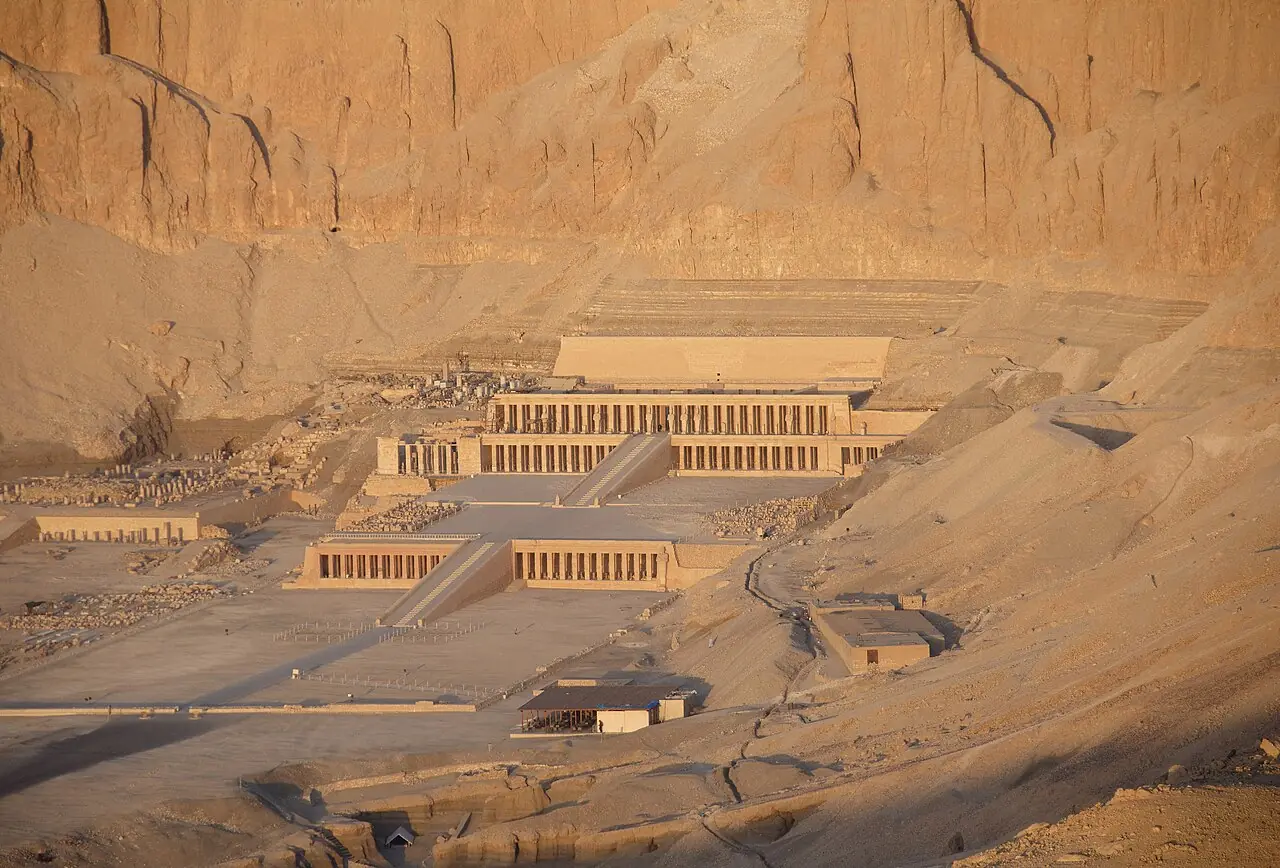 Photo: Wouter Hagens · CC BY-SA 3.0
Published by Adama Doumbia, founder of Afrique Unie · updated 28 November 2026 · our method and sources
Why go
On the West Bank of the Nile, opposite Luxor, the Temple of Hatshepsut seems carved out of the golden cliff that towers above it. Its three stacked terraces, linked by long ramps and lined with colonnaded porticoes, form one of the most striking works of ancient Egyptian architecture. The Egyptians called it Djeser-Djeseru, the “Holy of Holies”. It was built about 3,500 years ago, during the 18th Dynasty, for Hatshepsut, one of the very few women to rule as pharaoh.
The temple, dedicated above all to the god Amun, draws on the neighbouring temple of Mentuhotep II, built some six centuries earlier, yet its plan is unique. The reliefs in the porticoes of the middle terrace are among the most famous in Egypt: on one side, the expedition to the mysterious Land of Punt, with its ships and incense trees; on the other, the divine birth of the queen as the daughter of Amun. Two chapels, dedicated to Hathor and Anubis, flank this terrace, and the upper terrace is lined with tall statues of the queen in the guise of Osiris. The design is often attributed to Senenmut, her steward, though this is not certain.
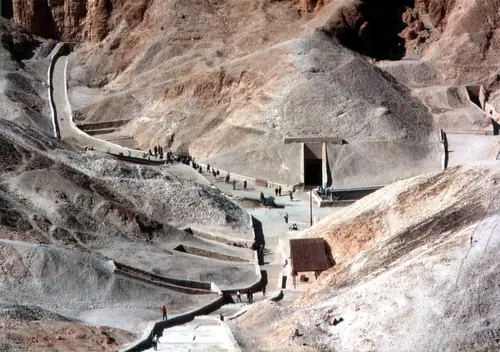
Some twenty years after Hatshepsut's death, Thutmose III had her name and images chiselled away, and the traces can still be seen. The temple was later damaged by time and an earthquake, then cleared in the 19th and 20th centuries. Since 1961, a Polish-Egyptian mission has been patiently restoring it. It is part of Ancient Thebes with its Necropolis, a UNESCO World Heritage Site since 1979, together with the nearby Valley of the Kings.
Getting there
The temple stands on the West Bank, opposite the temples of Karnak, about half an hour by road from central Luxor via the bridge, or about fifteen minutes by taxi after crossing the Nile by ferry. Most visitors combine it on the same day with the Valley of the Kings, the Colossi of Memnon and Medinet Habu, with a driver or on an organised tour. From the site entrance, an electric shuttle or a few hundred metres on foot take you to the foot of the terraces.
Frequently asked questions
How long does it take to visit the Temple of Hatshepsut?
Allow about an hour to an hour and a half to walk the three terraces, look at the Punt and divine birth reliefs and climb up to the sanctuary of Amun. The temple is usually visited as part of a half day on the West Bank, together with the Valley of the Kings.
How do you get to the Temple of Hatshepsut from Luxor?
The easiest way is to book a taxi or a driver for the day on the West Bank, or to join an organised tour. You can also cross the Nile by public ferry or motorboat and take a taxi on the other side. Agree on the price and the route before you set off.
When is the best time to visit the Temple of Hatshepsut?
From October to April, temperatures are more bearable, although winter mornings can be cool. From May to September, the heat in the Deir el-Bahari amphitheatre is overwhelming, so visit at opening time. All year round, early morning brings the best light and the fewest crowds.
Do you need a guide at the Temple of Hatshepsut?
It is not compulsory, but a licensed guide or a good guidebook helps a great deal in reading the reliefs, especially the Punt expedition and the marks left by Thutmose III's erasures. Guards who spontaneously offer to show you a chamber will expect a tip.
Can you combine the Temple of Hatshepsut with the Valley of the Kings?
Yes, it is the classic pairing: the two sites are separated only by the Theban mountain and a few kilometres of road. Start early at the Valley of the Kings, then go on to the temple, or the other way round depending on the crowds. Add the Colossi of Memnon, Medinet Habu or Deir el-Medina if you have the whole day.


 Algeria
 Morocco
 Tunisia